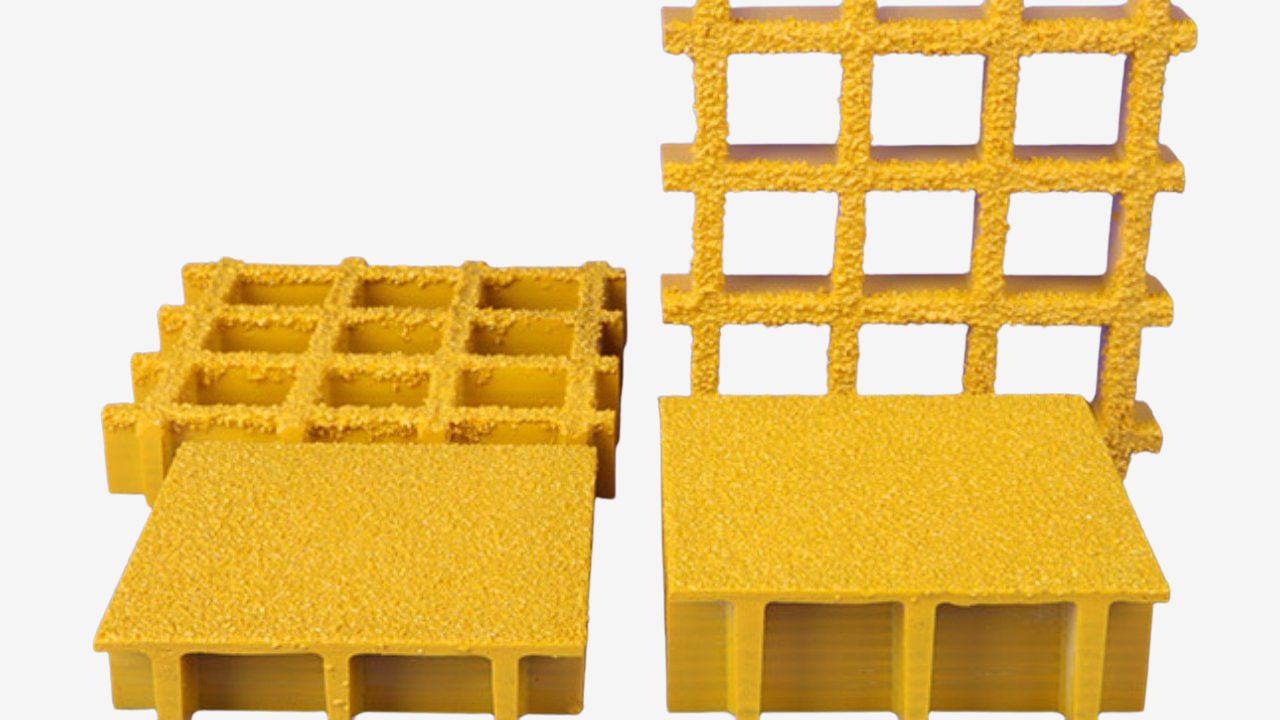
In industrial platforms, the rinsing area usually requires the water to be drained quickly, while the maintenance walkway above the equipment may need to prevent nuts, tools and debris from falling. Covered FRP grating features a continuous solid surface, while open mesh FRP grating retains the through-hole mesh. This article will compare the two from several key aspects.
Key Differences
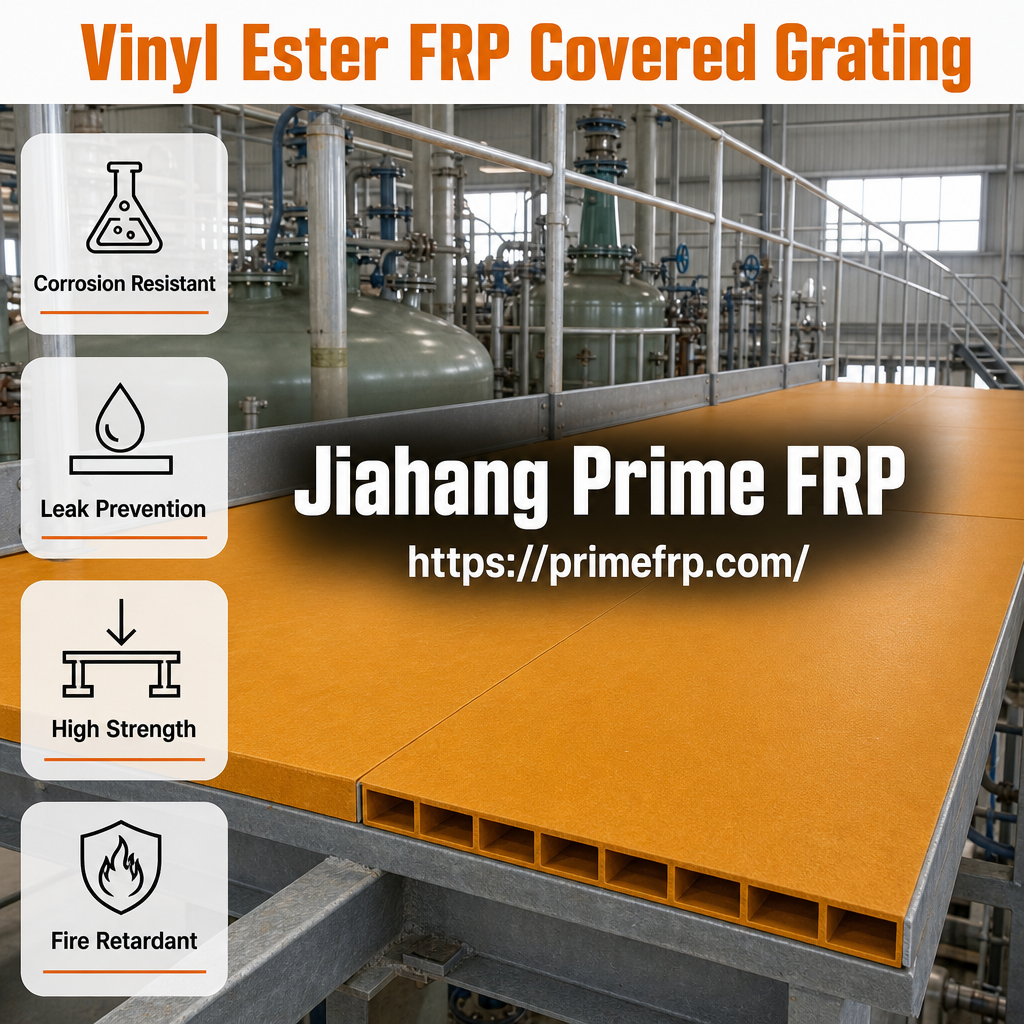
The covered FRP grating is usually composed of a bottom bearing grating and an upper solid FRP grating panel. You shouldn’t confuse it with a single fiberglass grating panel. The open mesh grating keeps the mesh holes unobstructed.
| Comparison Item | Covered FRP Grating | Open Mesh FRP Grating |
| Surface Structure | Continuous solid surface | Open mesh structure |
| Drainage | Surface drainage | Direct drainage through openings |
| Small Object Drop Prevention | Prevents small objects from falling through | Small objects may fall through |
| Small-wheeled Cart Access | Easier cart movement | Limited by mesh size |
| Ventilation & Light Transmission | Limited airflow and light | Good airflow and light transmission |
| Cleaning Requirements | Surface and drainage points | Mesh openings and areas below |
| Load Capacity | Check overall load data | Check load tables for specific sizes |
This table can help you make an initial judge, but it cannot replace the comparison of specific specification. You cannot evaluate the load-bearing capacity and anti-slip performance of the GRP grating panel solely based on whether it has a cover plate or not.
Drainage: What’s the Difference?
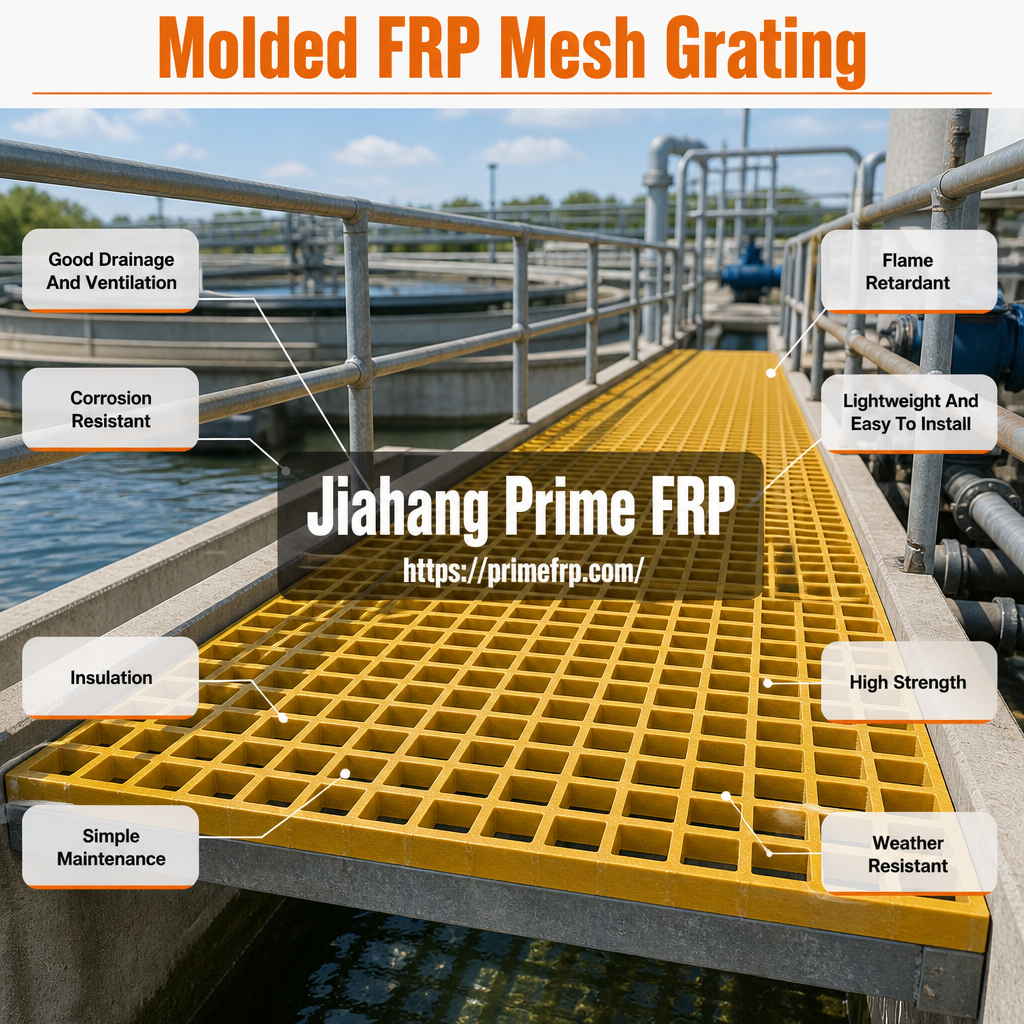
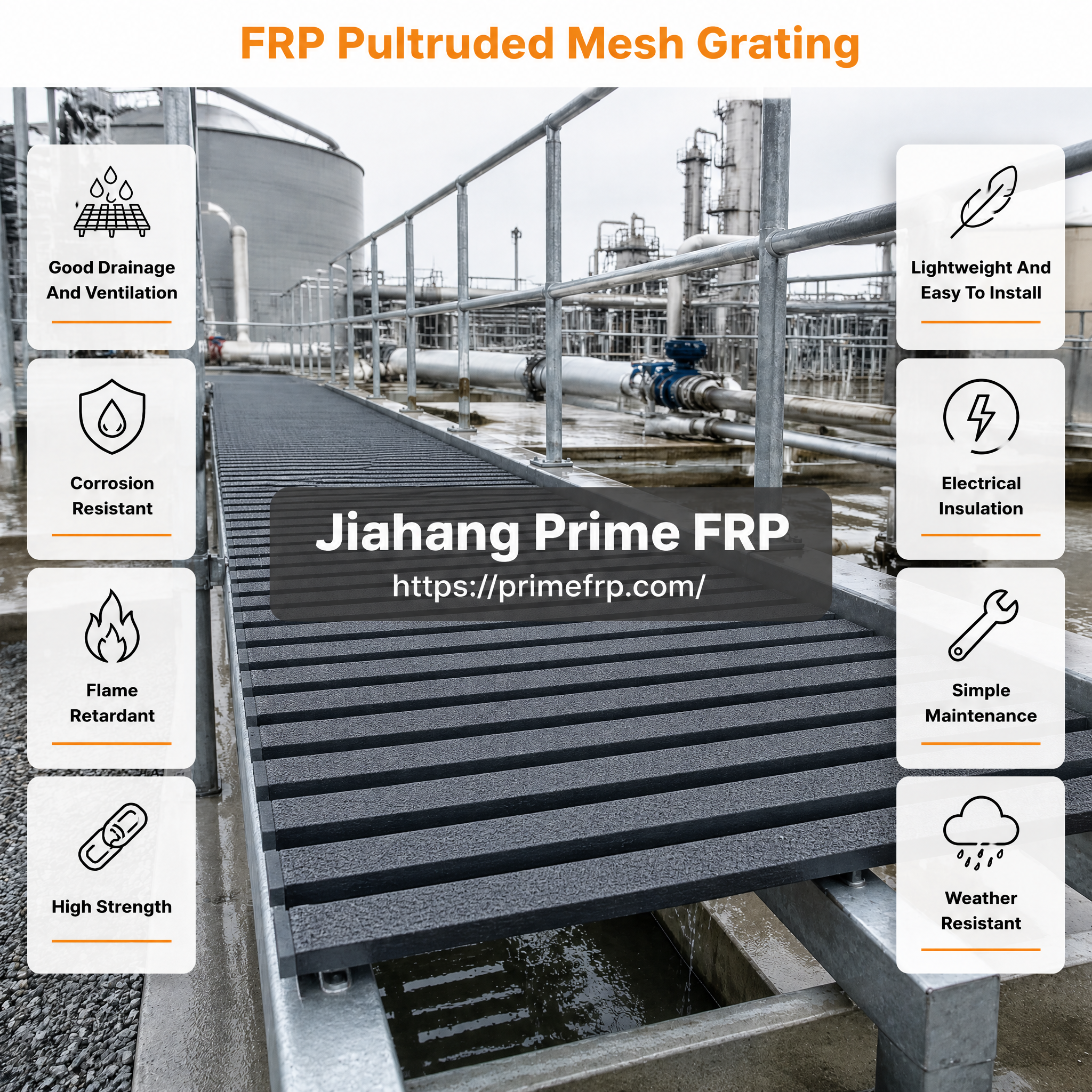
For open walkways, cleaning platforms, and areas prone to splashing water, the open mesh GRP grating performs better: The water can pass through the mesh, reducing the chance of staying on the walking surface. The open structure can also allow air circulation.
If there is a designed drainage ditch or wastewater collection area below, an open structure is usually more suitable. If there are electrical equipment, product conveying lines, or other workers below, direct downward drainage may cause new problems.
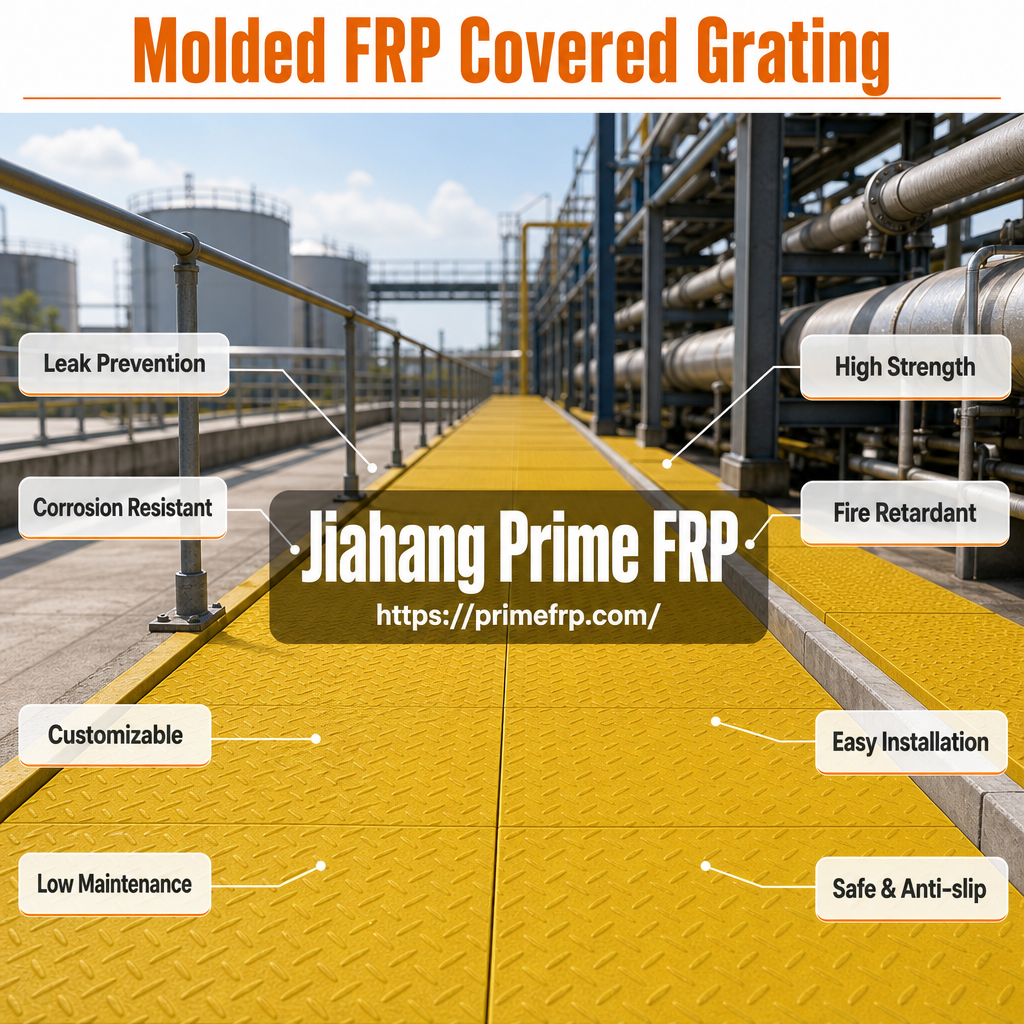
The FRP covered grating can prevent liquids from passing directly through the grating plate, but the water still needs to be drained. When designing, you should confirm the slope, drainage direction, and collection location to avoid water flowing through the area where people are standing or entering adjacent equipment areas.
For example, for the same cleaning platform, if wastewater collection is allowed below, you can give a priority to an open structure; if you need to protect the equipment located in the areas below, you should consider a cover plate structure, along with the drainage measures of the surface.
Therefore, you should not directly equate “wet area” with “a covered grating”. What truly determines the structure is the drainage path of the whole area.
Protection of Areas Below: What Needs to Be Blocked?
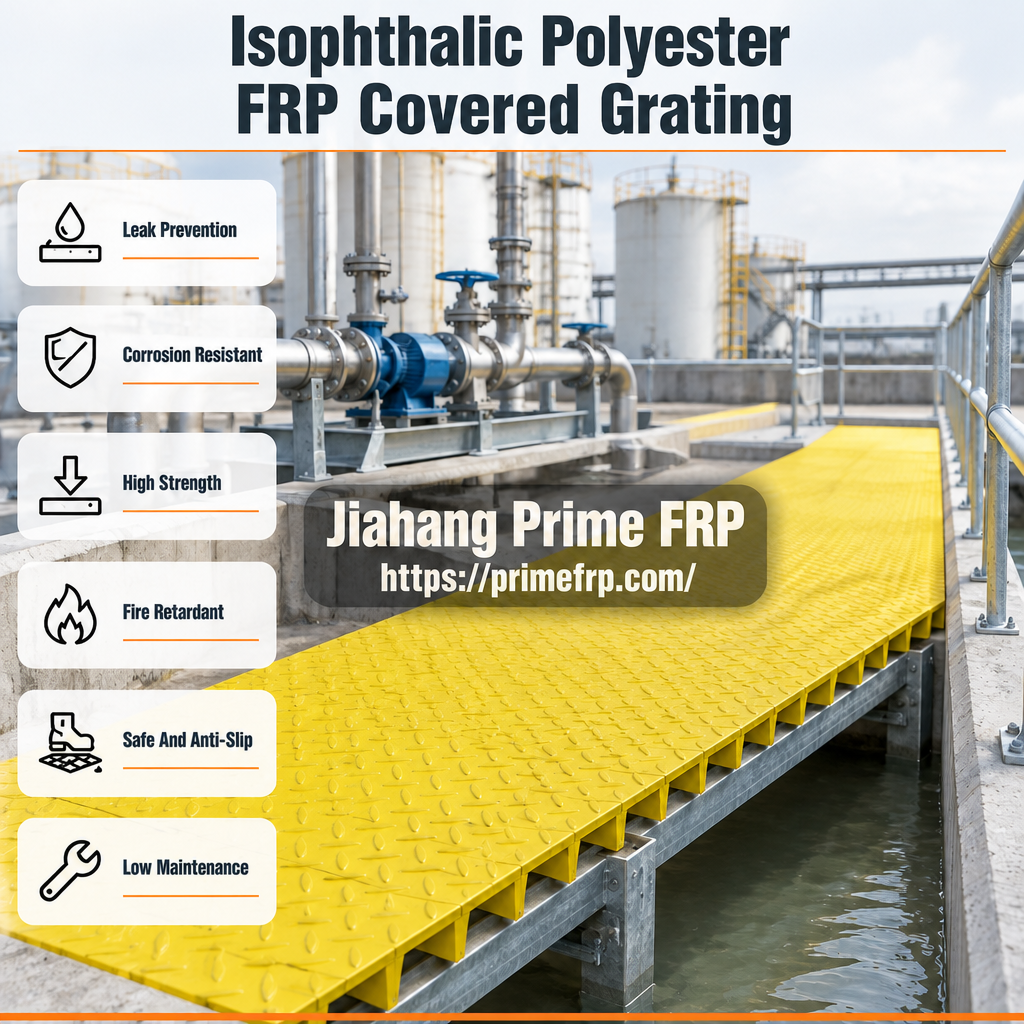
On the elevated maintenance platform, a fallen nut could affect the operation of the equipment below, and a dropped tool could endanger the personnel below. For such situations, the continuous surface of the covered grating has clear value.
However, you need to know the protection range. The continuous surface of the cover plate can reduce the falling of items through the mesh, but it cannot deal with all the falling paths. The edges of the platform, pipe openings, and gaps between the plates still need to be handled according to the on-site situation.
When choosing, you can judge according to the type of items:
- Small parts, debris or powder: If it is not allowed to fall into the area below, you should prioritize thecovered FRP grating.
- Larger tools and materials: In addition to the panel surface, you should also inspect the edges of the platform and the areas around the openingsfor protection.
- Liquids or odors: You should further design joints, sealing and ventilation, instead of merely adding a cover plate.
You should particularly note that a solid panel surface does not equate to a watertight or airtight system. If you require a leak-proof cover plate or an odor control system, you should clearly state these requirements in the inquiry, rather than simply write “Covered FRP Grating”.
Passage: Different Requirements
If the platform is mainly for people wearing work shoes to pass through, open mesh grating with the appropriate size usually can meet the requirements for use. At the same time, you should carefully check the clear opening size, anti-slip surface and the flatness after installation.
If the tools carts, hand carts or carts with small casters are frequently used in the platform, you should have a more detailed comparison. The smaller casters may be affected by the net holes, resulting in bumps, uneven rolling or local jamming, depending on the wheel diameter, wheel width and opening size. The covered grating provides a continuous surface, which can reduce the impact of the net holes on rolling, but it does not mean that any cover plate type product is suitable for carts. Therefore, you still need to confirm:
- The maximum load of a single wheel and the contact area of the wheels;
- Whether the joint of the plates is smooth;
- Whether the surface texture significantly increases the rolling resistance;
- Whether the panels and the bottom gratingsare suitable for repeated wheel loads.
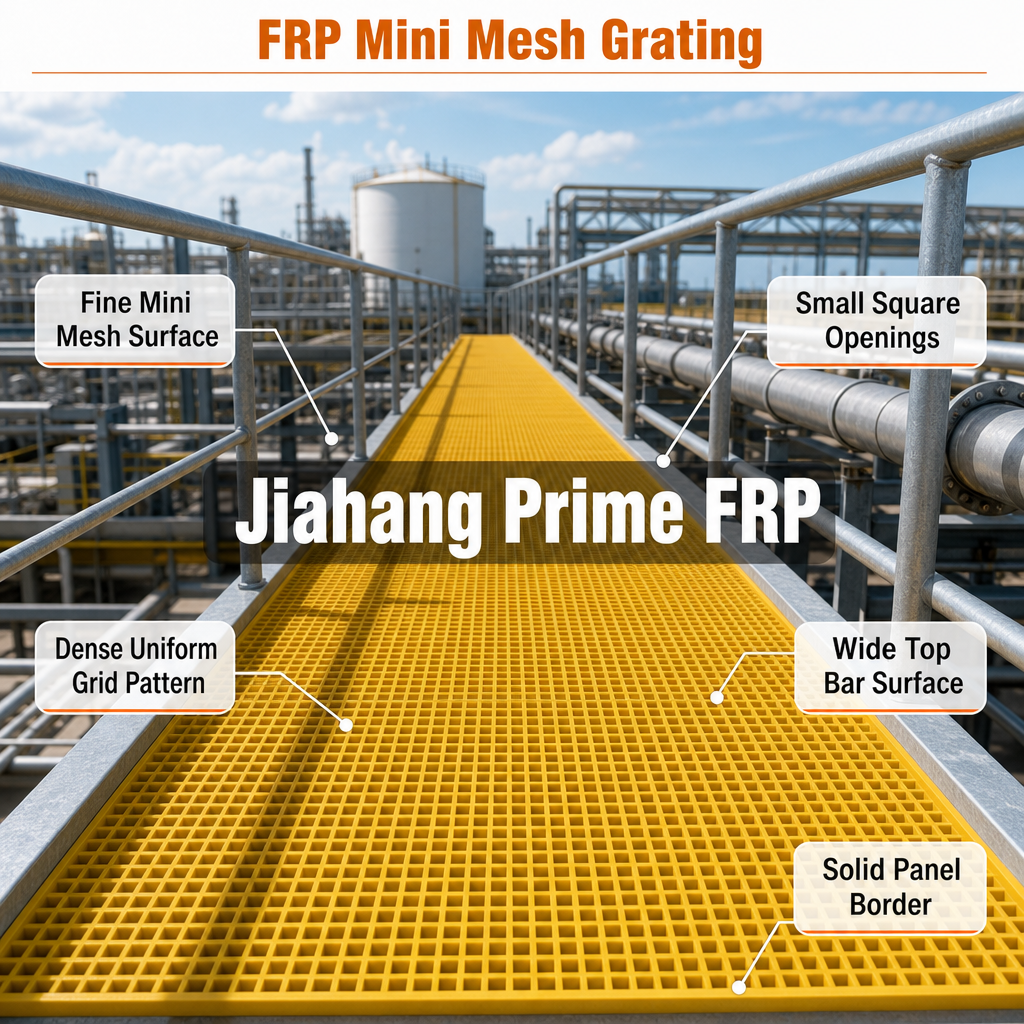
For example, the covered grating suitable for personnel passages should not be directly used for heavy material cart routes. For small wheel cart areas, you should also consider wheel parameters besides the total weight of the vehicle. If you need drainage but concern that the net holes affect passage, you can further evaluate the grating with small net holes or micro net holes. However, they still have openings and cannot completely replace solid surfaces.
Load Capacity: Does a Cover Plate Always Mean Higher Load Capacity?
While cover plates may improve the stiffness or partial load distribution of certain composite products, this does not mean that all covered grating inherently outperform open mesh grating in load capacity. The actual performance depends on the grating structure below, thickness of the panel, method of combination, support span, and type of loading. You should select based on the specific load and deflection data of the product.
When comparing quotations, you are particularly easy to overlook three issues:
First, verify whether the indicated thickness refers to the same dimension. Covered grating may list total thickness, while others specify respective thicknesses for the base grating and the top panel. If you don’t distinguish, two quotes might appear similar in specifications, yet their actual structures could differ significantly.
Second, confirm whether the types of loads being compared are consistent. Uniformly distributed loads from personnel, concentrated point loads from equipment feet, and wheel loads from carts cannot be directly substituted for one another. It is also essential to confirm how well the panel performs under localized loading conditions.
Third, check whether you verify the allowable deflection. The fiberglass grating panel not only needs to meet the requirements for strength, but also keep deformation within acceptable limits defined by the project. Otherwise, it could affect the comfort of walking, joint integrity, and cart passage.
If pultruded fiberglass grating is used as the base, you should also confirm the direction of the bearing bar. The bearing bar should span across supports. You should ignore the correct installation direction of the underlying structure even if a covered plate is add on the top of the grating.
Slip Resistance: Select the Structure and Surface Respectively
Open mesh GRP grating panels offer more convenient drainage, but it does not mean they are more slip-resistant in various slippery conditions. The continuous surface of the covered FRP grating panels does not necessarily mean they are not anti-slip.
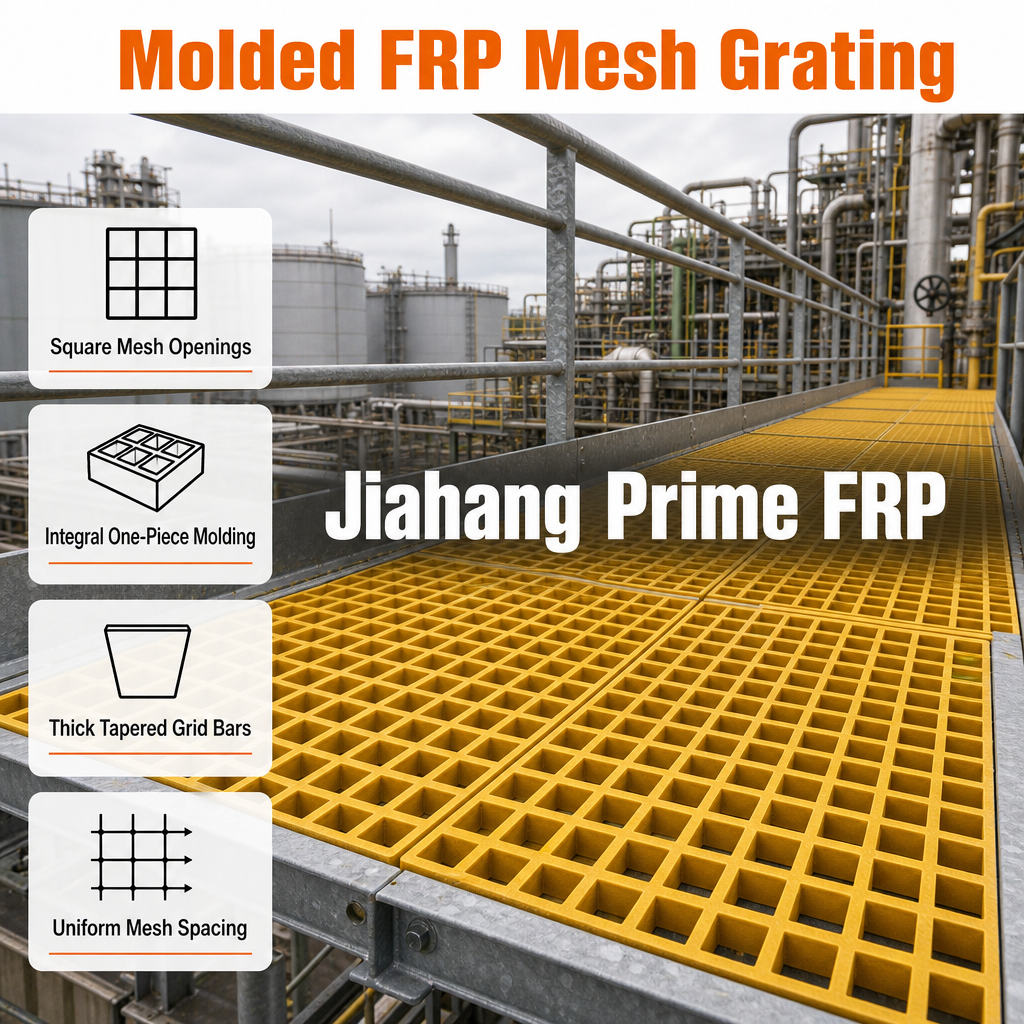
The slip resistance is related to the surface, contaminants, shoe soles and maintenance. The molded FRP grating with open mesh structure includes concave grating and grit grating. When selecting, you should specify the specific surface rather than just “anti slip grating”.
For clean water environments, you should pay attention to drainage and wet-state slip resistance; for oily environments, you should consider the residue of oil film and cleaning methods; for sludge or fine powder environments, you should check whether the contaminants are prone to cover the surface texture or block the mesh holes.
A practical approach is to describe the actual conditions for use to the supplier and request samples consistent with the delivered surface. If you require a slip resistance test report for your project, you should also confirm whether the test method and test conditions meet the requirements of your project. Covered grating and open mesh grating solve the problem of “whether the surface is continuous”, while you need to determine the slip resistance configuration additionally.
Maintenance: Which Is More Convenient?
In terms of the maintenance cost, you should not only judge whether the upper surface of the FRP gating is easy to clean, but also consider where the dirt ends up.
The covered FRP grating leaves most debris on the upper surface, which is convenient for centralized cleaning, especially suitable for areas where you don’t want debris to fall into the equipment below. However, the anti-slip texture, board gaps and edges may still accumulate dirt, and the cleaning water also needs an emission path. The open mesh FRP grating allows some debris to pass through, but it does not mean you don’t need to clean the surface. Fibers, packaging fragments or larger debris may get stuck in the mesh holes. In addition, the debris passing through the mesh holes may also increase the cleaning of the areas below.
For the groove covers that need to be disassembled frequently or maintenance platforms, you also need to confirm the weight of each single piece, the size of the sections, and the lifting method. The self-weight of the whole grating will increase when the panels are added to the bottom grating, and overly large plates may affect the maintenance. When inspecting covered grating, you should also pay attention to panel wear, cracking, edge warping, and abnormal conditions at the bonding areas, rather than just check whether the surface is intact.
Cost: What Should You Compare?
When the configuration of the bottom grille is similar, as the cover-type products increase the panel and the corresponding processing procedures, the purchase cost usually rises. However, the final quotation still depends on the specifications, resin, quantity and processing requirements, and you can’t judge the difference of the prices solely based on the open mesh structure or cover plate structure. For a meaningful cost comparison, you should not only focus on the prices of the material, but also take the following expenses into account:
| Cost Item | Details to Confirm |
| Materials | Resin type, underlying structure, panel thickness, and surface finish |
| Processing | Cutting, drilling, edge treatment, and cover plate bonding |
| Installation | Supports, fasteners, joints, and height adjustments |
| Drainage and Protection | drainage, liquid collection, or localized measures to prevent objects from falling |
| Long-Term Maintenance | Cleaning requirements, ease of removal, and replacement methods |
For instance, the unit price of an open mesh grating is relatively low. Nevertheless, if a protective panel needs to be added below after installation, you should compare the cost of the complete solution. Conversely, if the platform only requires rapid drainage, you don’t necessarily use a cover plate, which will result in additional drainage.
Confirm Five Issues Before Purchase
In order to enable the suppliers to provide feasible suggestions and comparable quotations, you should provide the following information:
- Purposefor use: for personnel walkways, cart passages, equipment platforms or maintenance covers.
- Surrounding environment: whether water, debris and small parts are allowed topass through, and whether there are people or sensitive equipment below.
- Dimensions and load capacity: net span, support position, plate size, concentrated load or wheel load, and allowable deflection.
- Contact conditions: chemical media, concentration, temperature, contact frequency and cleaning methods.
- Delivery scope: surface form, fasteners, openings, edge treatment, and drainage or sealing requirements.
For the covered FRP grating, you need to additionally confirm the thickness of the bottom grating, the thickness of the panel, and the load-bearing data of the complete combined product; for the open mesh grating, you should define the net size of the mesh holes. What’s more, you can use the two types of grating separately in different zones of your project: the ordinary open walkway retains the open structure, while the local area above sensitive equipment or where push carts pass in a concentrated manner adopts the cover plate type.
FAQs
1. Can the covered FRP grating be cut on site?
Yes. It can be cut based on the installation dimensions, but you should use tools suitable for fiberglass grating and deal with the cuts according to the supplier’s requirements. Besides, you should also check the bonding condition of the panel edges after cutting to avoid looseness, delamination or exposure of unprotected fibers.
2. Can the open mesh fiberglass grating be equipped with a cover plate?
It can be evaluated for installation, but you should first confirm whether the grating has any cracks, deformations or aging, and the supporting conditions. The material, thickness and fixation method of the cover plate need to match the original structure instead of simply laying the cover plate on the grating.
3. Can the covered FRP grating replace the fireproof partition?
It cannot be used as a fireproof partition merely based on its solid surface. The fire resistance and fireproof separation capability are different requirements. Even if the product has a flame propagation test report, it does not mean that it can prevent flames and high temperatures from penetrating. If it is to be used as a fireproof partition, you should confirm whether the product and its installation structure meet the requirement for fire resistance.
4. If the panel of the covered grating is damaged, can you just replace the panel alone?
Whether it can be replaced individually depends on the way the panel is combined with the bottom grille and the extent of the damage. Some products require a complete replacement. If you discover cracks or delamination, you should first inspect the bottom load-bearing structure. You shouldn’t directly cover the new panel as it may hide the existing damage.
5. Can open mesh FRP grating and covered FRP grating use the same grating fixing clips?
Not necessarily. The fixing clips for open mesh grating usually need to match the mesh and bearing bars. While the covered grating may require different mounting hole positions or fixing methods. You should select based on the plate type, support form and disassembly requirements, and avoid directly using the original fixing clips.
Final Thoughts
When selecting open mesh FRP grating or covered FRP grating, you should determine the requirements of your project. The former is more suitable for areas that require drainage, ventilation and light transmission; the latter is more suitable for areas that require a continuous passageway surface and to reduce the falling of debris downward.
Jiahang Prime FRP is committed to offering one-stop solutions for composite materials. If you want to learn more, welcome to look through our website — Jiahang Prime FRP (https://primefrp.com/) and contact us at any time.