As to FRP grating installation, choosing the appropriate fixing clips is crucial for the stability of the installation and the safety for use. Different types of FRP grating clips vary in structure, installation methods and applicable scenarios. This article will introduce the types of common clips, installation methods and other details.
Why Are Fiberglass Grating Clips Necessary?
FRP grating clips are primarily used to fix FRP grating panels onto the underlying support structures, preventing movement during use. In industrial platforms, maintenance walkways, and stair treads, grating may be subjected to impacts from foot traffic, equipment vibration, forklifts, and routine maintenance activities. If you just placed the fiberglass grating panels directly on support beams without reliable fastening, you may be faced with the following issues:
- Panel displacement: Foot traffic or equipment vibration can gradually shift the grating from its original position.
- Edge lifting: When uneven loads act on localized areas of the FRP grating plate, unfixed edges may be lifted
- Low stability of installation: Relative movement at panel joints may occur, affecting the safe passage of people.
- Maintenance risks: Removable grating, if not properly refixed with fiberglass grating clips after reinstallation, may pose safety hazards.
You should note that the primary function of the grating fixing clips is to limit displacement and lifting and they cannot replace the support beams in carrying the design load of the grating. Therefore, you should verify the support span, load-bearing direction, and supporting conditions of the grating.
Common Types of FRP Grating Clips
The common types of grating clips in industrial FRP gratings include M-type, J-type, C-type and some special fixing components.
1. M-clips (Grating Saddle Clips)
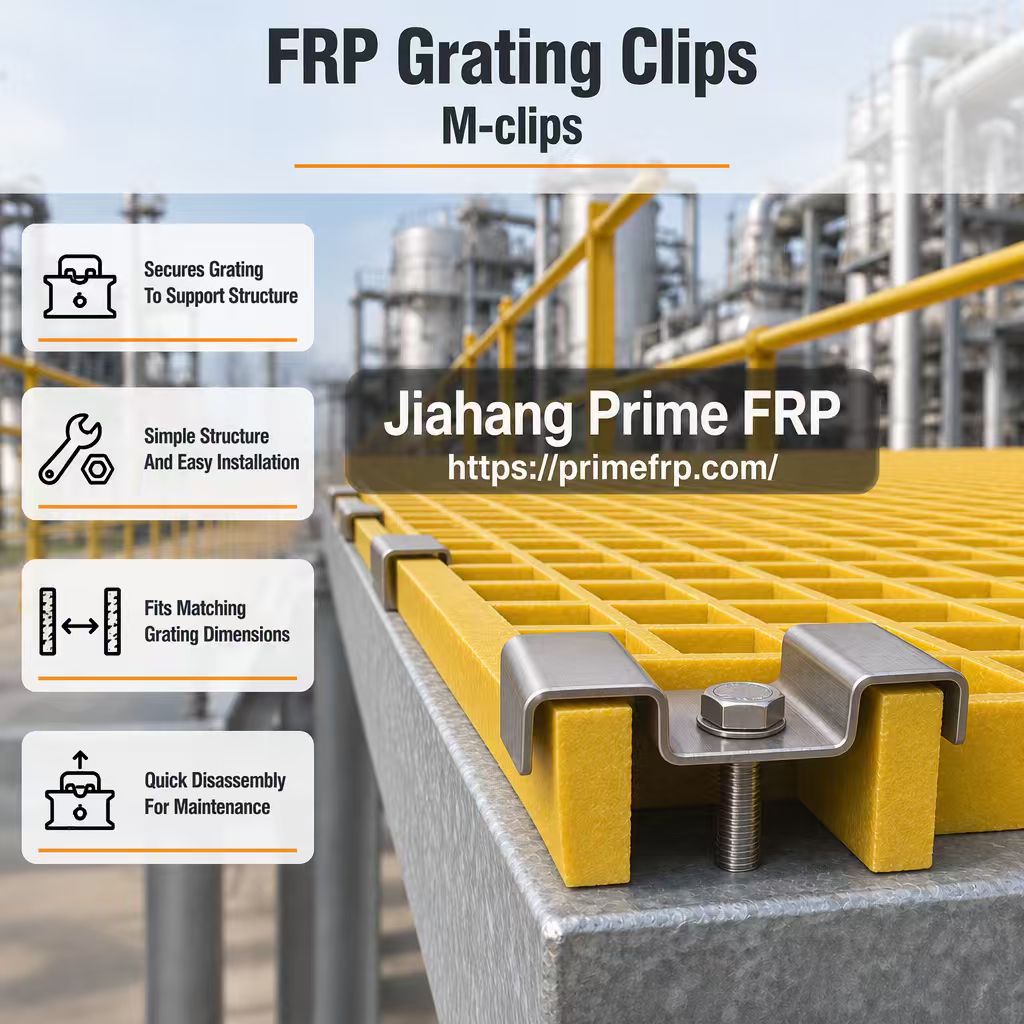
M-clips for fiberglass grating, also called saddle clips for grating, usually have a structure capable of spanning the grating bearing bars or adjacent ribs, and it press the grating firmly onto the lower support member by bolts. M-clip is one of the common fixing methods in molded fiberglass grating.
Key features:
- It can fix the grating at the appropriate position onto the supporting structure.
- It has relatively simple structure for installation, making it easy for inspection and disassembly.
- It is suitable for FRP mesh grating with dimensions matching it.
- It can be used in maintenance areas where the grating needs to be disassembled regularly.
Application scenarios: industrial walkways, sewage treatment plant platforms, equipment maintenance passages, etc.
When selecting, you should confirm whether the M-clip for grating matches FRP grating thickness, the spacing of the bearing bars, and the top shape. If the grating fixing clips cannot be properly attached to the grid, the problems such as insufficient compression or uneven force distribution may arise.
2. J-clips
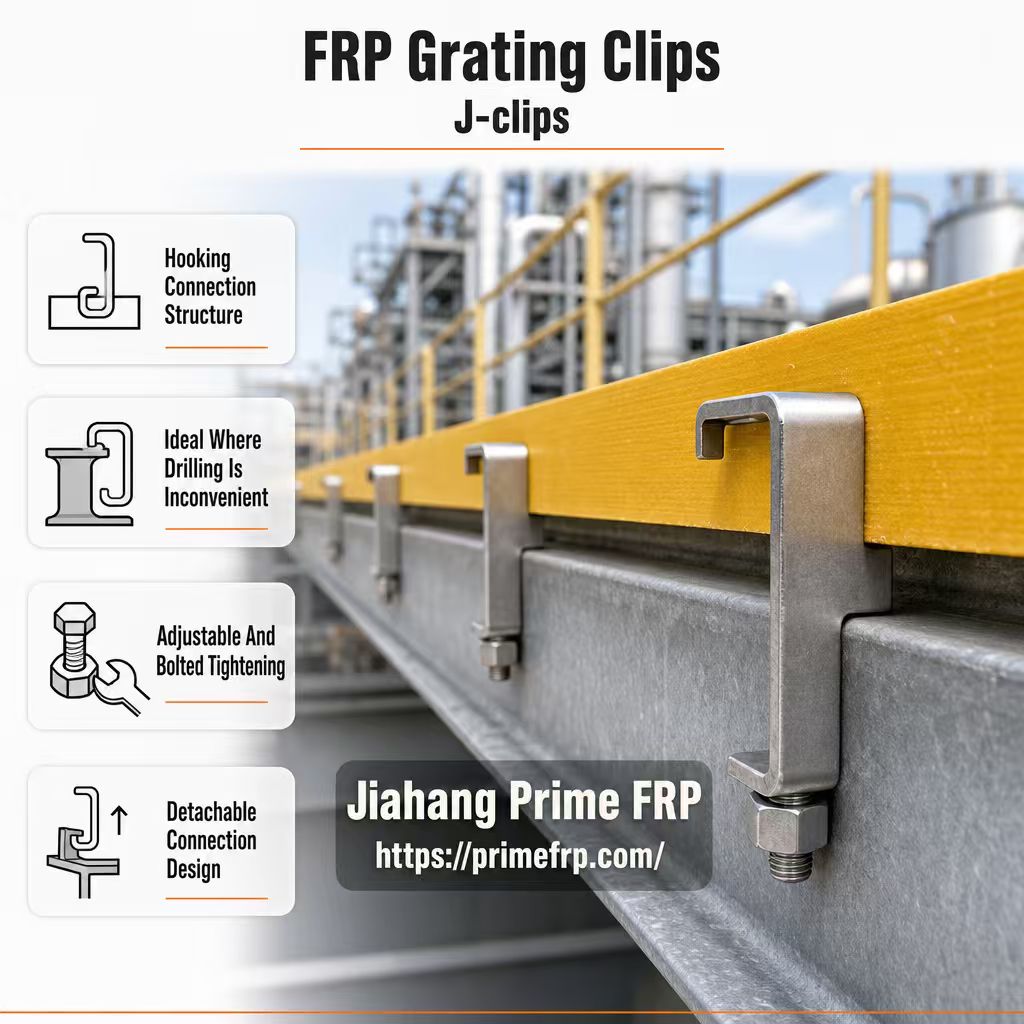
The J-shaped fixing clips usually adopt a hooking connection structure. J-clips are typically used to secure fiberglass grating panels by hooking onto suitable support structures, often with compatible fasteners. Compared with some fixing methods that require drilling holes directly on the supporting beams, certain J-shaped fixing systems can reduce the on-site drilling work, but this depends on the design of the grating.
Main features:
- It can connect the grating with the supporting components through the hooking structure.
- Some designs are suitable for installation positions where drilling holes on the supporting beams is inconvenient.
- It can be adjusted and tightened by bolts.
- You should check the size of the hook and whether it matches with the supporting structure.
Applicable scenarios: Some steel structure platforms, equipment walkways, and areas requiring detachable connections.
You should pay attention that the J-shaped fixing clips are not a universal product. The thickness, shape, and installation space of different supporting beams may determine whether a certain J-shaped fixing clip is applicable.
3. C-clips
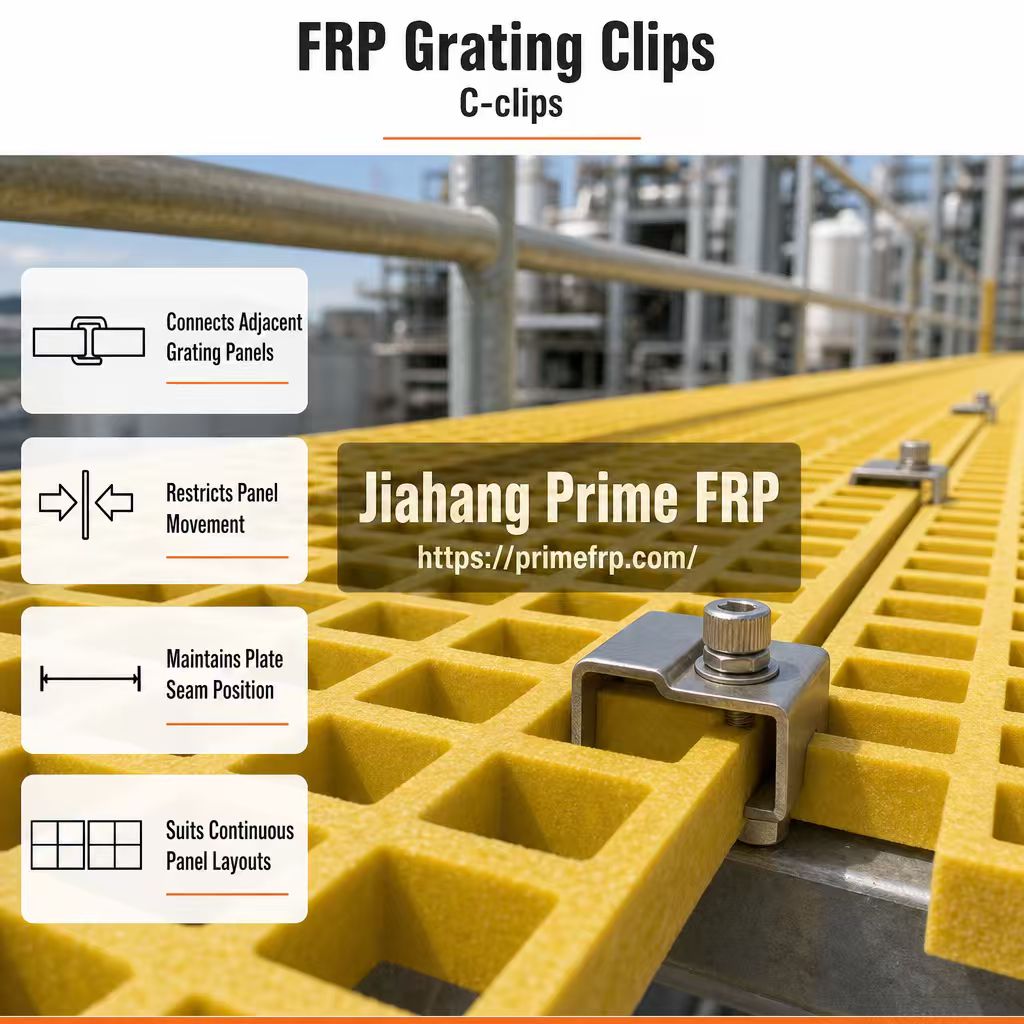
The C-type fixing clips are usually used to connect adjacent FRP grating panels and restrict the movement between the plates. Unlike the main fixing clips that are used to fix the grating onto the supporting beams, some C-type connection clips are mainly used for connecting the plates to each other.
Key features:
- It can connect the adjacent grating plates.
- It helps maintain the relative position of the plate seams.
- It is suitable for areas where multiple grating plates are laid continuously.
- Before installation, you should confirm the structure and connection position of the adjacent grating plates.
Application scenarios: large industrial platforms, walkways and equipment platforms where multiple grating plates are joined together.
You should pay special attention that the C-type clips used to connect two grating plates cannot automatically replace the fixing parts between the grating and the supporting beam. If your project requires both panel-to-panel connection and grating-to-support connection, you should confirm the connection requirements of the two methods respectively.
4. Other Specialized FRP Grating Clips
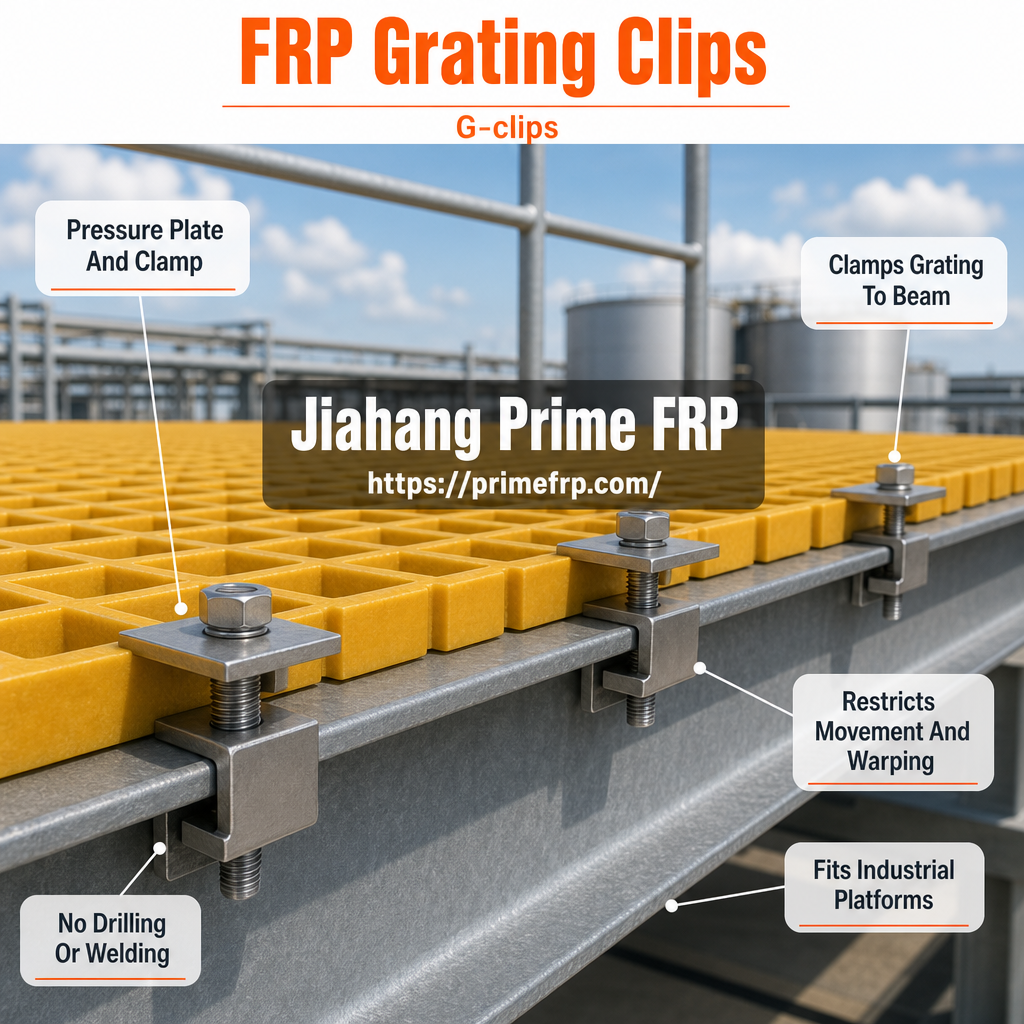
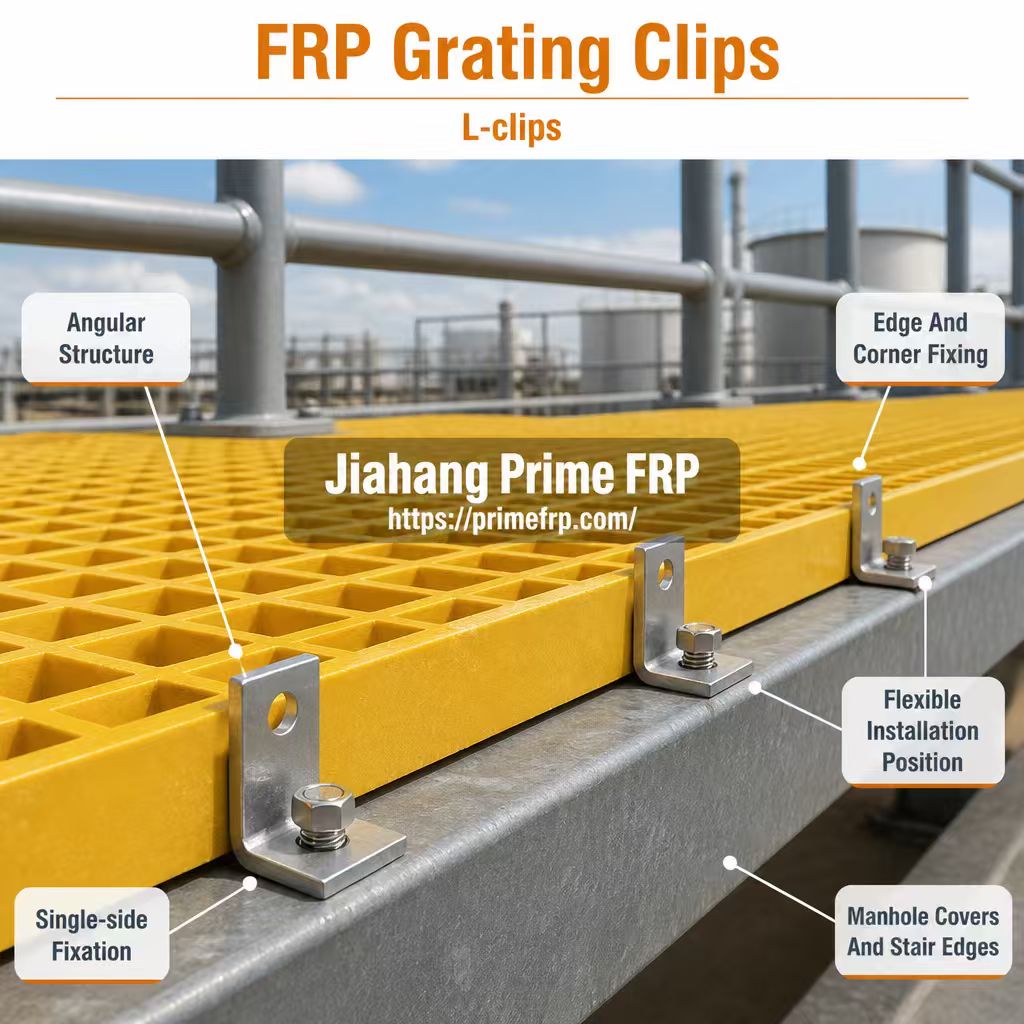
In addition to the common M-type, J-type and C-type clips, there are also L-type and G-type clips. The L-shaped fasteners is usually used for fixing at the edge of the grating or at special positions, while the G-type clip fixes the grating to the supporting beam through a clamping mechanism. When choosing, you should confirm the compatibility of the GRP grating fixing clips with the grating specifications and the supporting structure.
Moreover, some pultruded fiberglass grating, covered FRP grating, and grating with special structure require special fixing clips. For example, the load-bearing strips of FRP pultruded grating usually have a definite directionality. The shape and spacing may be different from those of FRP molded grating. Therefore, you cannot assume that the two can use the same fixing clips. For FRP covered grating, since there are no open mesh holes at the top, you need to reserve fixed holes before installation. Therefore, when choosing clips for grating, you cannot only rely on the name to make a judgment. You should also check the structure diagram of the product and installation instructions.
How to Select the Right FRP Grating Clips?
After understanding the basic types of fiberglass grating clips, you also need to make a judgment based on the grating structure and the actual installation conditions.
The following comparison table can help you make an initial selection:
| Clip Type | Main Function | Suitable Applications |
| M-Clips | Secure grating panels to support beams | Molded FRP grating and some pultruded FRP grating |
| J-Clips | Secure grating using a hook-shaped design | Specific support beams and individual bearing bar connections |
| C-Clips | Connect adjacent grating panels | Joining multiple molded fiberglass grating panels |
| L-Clips | Secure panel edges or specific positions | Trench covers and platform edges |
| G-Clips | Secure grating to support beams using a clamping mechanism | Compatible molded or pultruded FRP grating and support structures |
| Specialized Clips | Fit specific grating structures | Covered FRP grating and special pultruded FRP grating |
The above are common types of grating hold down clips, but they do not represent a unified industry classification standard. The C-type, J-type or other fixtures from different manufacturers may have different structures, and you should refer to the actual product drawings for details.
1. Selecting Based on the Grating Types
For molded fiberglass grating, you can give priority to the M-type clips. If multiple grating panels are laid continuously, you should also assess whether C-type clips are required based on the joint position.
For fiberglass pultruded grating, you should pay special attention to the direction of the load-bearing bars, the cross-sectional shape, and the transverse connection structure. Since pultruded FRP grating has directional load-bearing properties, the fixing clips must be properly matched to the designated bearing bars and support structure.
For covered FRP grating, the continuous panel on the top may restrict the installation position of ordinary fixing clips. Therefore, you should confirm whether drilling is allowed and whether there are corresponding fixing components for cover plates.
2. Clip Material Selection Based on the Installation Environment
Even though fiberglass grating has excellent corrosion resistance, the metal fasteners may still be affected by moisture, salt fog and chemical media. Common materials include:
- 304 stainless steel grating clips: They are suitable for many ordinary indoor and general industrial environments.
- 316 stainless steel grating clips: They are generally more suitable for environments with chloride, coastal or higher corrosion risks, but you should confirm the specific medium and concentration.
- Galvanized grating clips: They can be used in some environments with lower corrosion risks, but you should evaluate the long-term durability of the coating.
For wastewater treatment plants, chemical plants and offshore platforms, you should not only check the corrosion resistance of the grating resin, but also confirm whether the fasteners, bolts, nuts and washers are suitable for the same application environment.
3. Selecting Based on the Support Structure
The gratings installed on steel beams, angle bars, channel bars or FRP profiles may require different fixation methods. For instance, some clamps need to pre-drill holes on the supporting beams, while others can be fixed by clamping the flanges of the beam. If on-site drilling is not allowed for the project, you should confirm whether there are suitable no-drilling clamps available in advance, rather than changing the connection method temporarily when installing.
How to Install FRP Grating Clips: Step-by-Step Guide
Once you determine the type of the fixing clips, you should ensure that the installation position and the tightening method are correct.
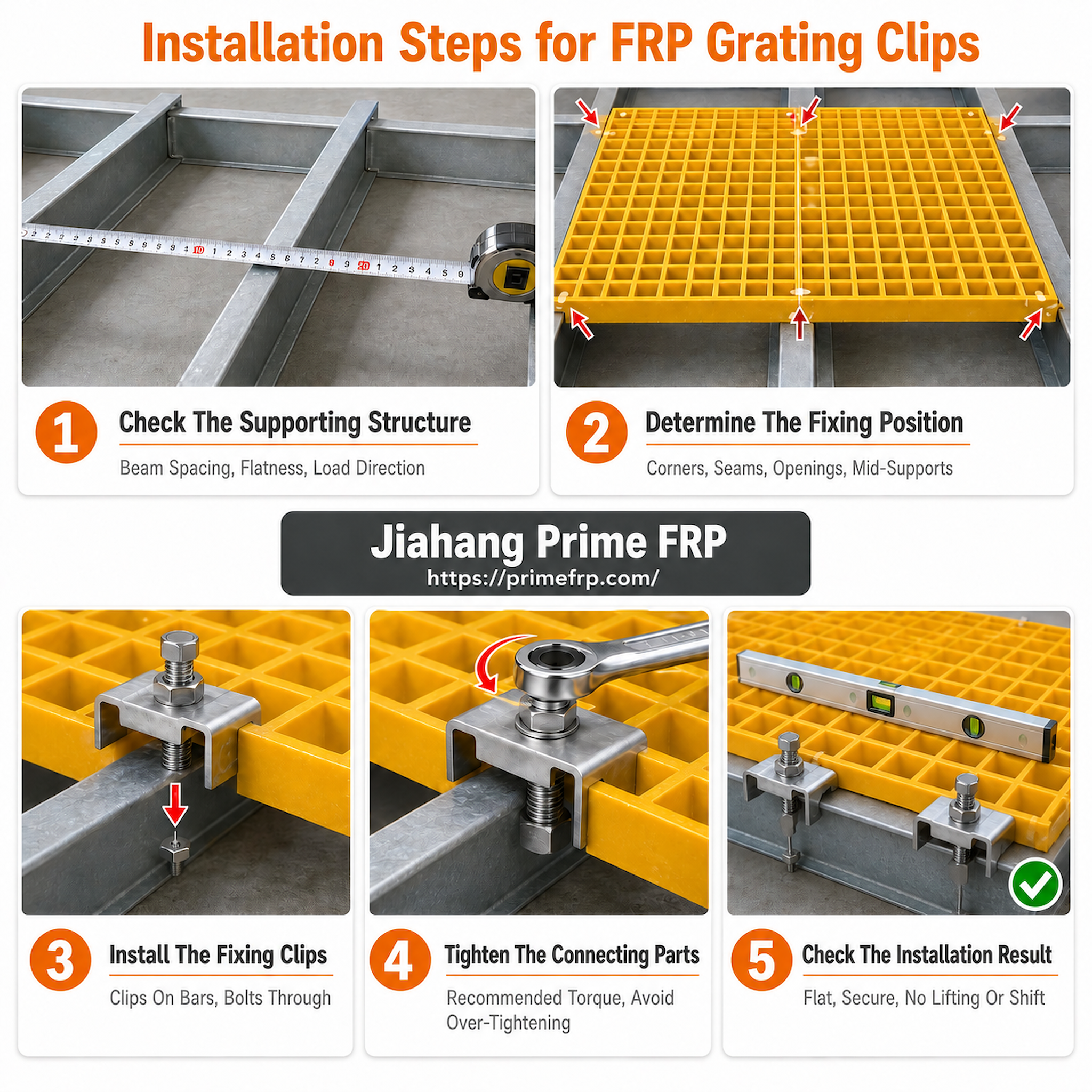
Step 1: Check the supporting structure
Confirm the spacing of the supporting beams, the flatness of surface and the load-bearing direction of the grating. The gratings should be stably placed on the supporting structure and cannot be forcibly flattened by the fixing clips to avoid obvious height differences in the plates.
Step 2: Determine the fixing position
Mark the fixing points based on FRP grating sizes, the position of the supporting beams and the requirements of your project. Usually, you should focus on checking the four corners of the plates, the seams, the areas near the openings and the middle support positions.
Step 3: Install the fixing clips
Place the fixing clips at the designated position, ensure that they are correctly adhered to the grating bearing bars or the edges of the grating panels, and then use the matching bolts and other connecting parts for fixation.
Step 4: Tighten the connecting parts
Operate according to the manufacturer’s recommended tightening method and torque. You should avoid over-tightening to prevent local compression of the grating, surface damage or cracking of the load-bearing bars.
Step 5: Check the installation result
After completion, you should check whether the grating panels are flat, whether the fixing clips are loose, and whether there is any abnormal lifting or displacement of the edge of the grating panels. For detachable areas, you should also confirm whether they can be safely disassembled and installed in later maintenance.
Common Mistakes When Installing FRP Grating Clips
- Purchasing only based on the name of the GRP grating clips
Even though they are all called M-clips or saddle clips for grating, different products may be suitable for different mesh sizes and grating thicknesses. Before purchasing, you should check the specific dimensions besides the name.
- Using C-type clips instead of support fixings.
Connecting adjacent grating panels and securing the grating to the supporting beam are different. If you only connect the panels to each other without fixing the panels to the supporting structure, there remains a risk of overall movement or lifting.
- Ignoring corrosion resistance of FRP grating clips
In humid or corrosive environments, the fixing clips may corrode earlier than the grating itself. Therefore, in addition to considering the service life of the FRP grating, you should also evaluate the durability of the metal fittings.
- Over-tightening the bolts
The local compressive performance of FRP is different from that of steel. Excessive tightening force may cause damage to the bearing bars, which does not mean that the fixing performance is more excellent.
- Ignoring the requirement for later disassembly
For maintenance platforms that need to be opened regularly, you should select a connection method that is easy to disassemble and reassemble. What’s more, after maintenance, you should check whether all the fasteners have been correctly reset.
Details You Should Confirm Before Purchasing Fiberglass Grating Clips
In order to avoid problems such as size mismatch or installation difficulties after the purchase, you should provide the following information for the supplier:
| Purchasing Information | Details to Confirm |
| Grating Type | Molded, pultruded, or covered FRP grating |
| Grating Specifications | Thickness, mesh size, and bearing bar dimensions |
| Support Structure | Steel beams, angle steel, channel steel, or FRP profiles |
| Fixing Method | Whether drilling is permitted and whether access from below is possible |
| Application Environment | Damp conditions, salt spray, chemical corrosion, or normal indoor conditions |
| Installation Requirements | Fixing locations, number of fasteners, and whether disassembly is required |
| Accessories | Material of fixing clips, bolts, nuts, and washers |
If you are unsure about which type of fiberglass grating fasteners to use, you’d better provide the supplier with the specification diagram of the grating and the pictures of the on-site support structure to ensure compatibility.
FAQs
1. Can the FRP grating clips be reused?
Some stainless steel clamps can be disassembled and reused, but you should check whether there is deformation, corrosion, cracks or thread damage. If the clip has lost its original shape or cannot be securely fastened, you shouldn’t use it any longer. For maintenance platforms that are frequently disassembled, you need to check the wear condition of the connecting parts regularly.
2. Do FRP grating clips require regular maintenance?
Yes. Although stainless steel grating clips usually have excellent corrosion resistance, they may still become loose or damaged in humid, vibrating or chemically corrosive environments. You should develop an inspection plan based on the on-site risks, with a focus on checking the status of bolt tightening, the corrosion condition of the clips, and whether there is any abnormal displacement of the grating.
3. Can you use ordinary steel grating fixing clips to install the FRP grating?
It cannot be assumed that it is universally applicable. There may be differences in the size of the bearing bar, shape and local compression performance between the steel grating and the FRP grating. Even if a certain type of fixing clip can be installed, you should also confirm the contact area, tightening method and actual fixing effect. You should use connection components that have been verified by the supplier and are suitable for the corresponding FRP grating.
4. Do FRP grating clips require anti-loosening measures?
If the platform is frequently subjected to vibrations, repeated impacts or other dynamic forces, appropriate anti-loosening designs may be necessary, such as verified anti-loosening nuts or other mechanical anti-loosening structures. You should determine the specific solution based on the type of the fixing clips, bolt specifications and the on-site conditions, instead of relying only on increasing the tightening force.
5. Can the fixing clip be replaced alone if it gets damaged?
If the grating bearing bars, the supporting structure and the installation holes are not damaged, you can consider replacing the fixing clips separately. However, if there are cracks in the bearing bars, expansion of the holes or deformation of the supporting structure, you should check these issues first before choosing the repair method. Besides, you should make sure that the new fixing clips are compatible with the original connection system.
6.How many clips are required per FRP grating panel?
Generally, each FRP grating panel requires at least four fixing clips, positioned near the four corners. The spacing between clips along support beams should typically not exceed 48 inches (approximately 1.22 meters), subject to the manufacturer’s installation requirements. Larger panels, heavy-duty platforms, or high-traffic areas may require six or more clips. If joints between adjacent panels fall between supports, C-clips can help minimize relative movement between panels. However, C-clips should not replace the clips securing the grating to the support structure.
Final Thoughts
When selecting FRP grating clips, you should consider the type, size, supporting structure and application environment of the grating. Besides, you should confirm the compatibility between the grating fixing clips, the grating and the supporting structure before purchasing.
Jiahang Prime FRP is committed to offering one-stop solutions for composite materials. If you want to learn more, welcome to look through our website — Jiahang Prime FRP (https://primefrp.com/) and contact us at any time.