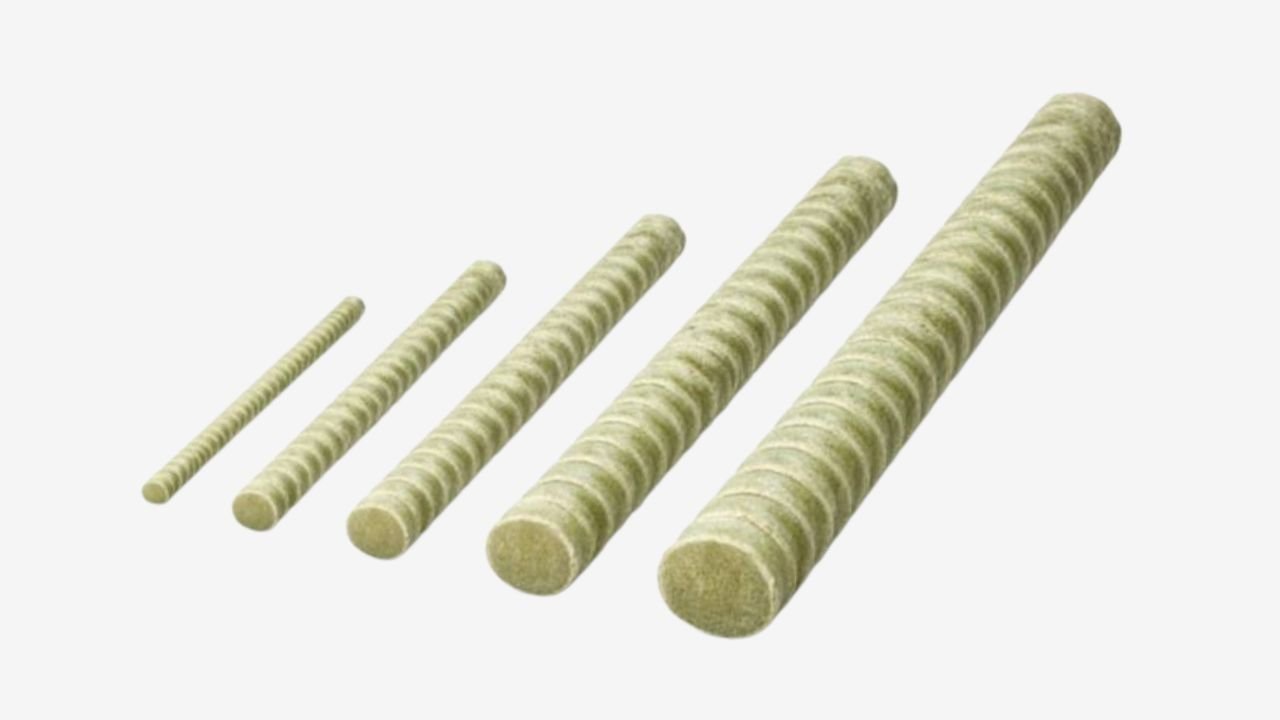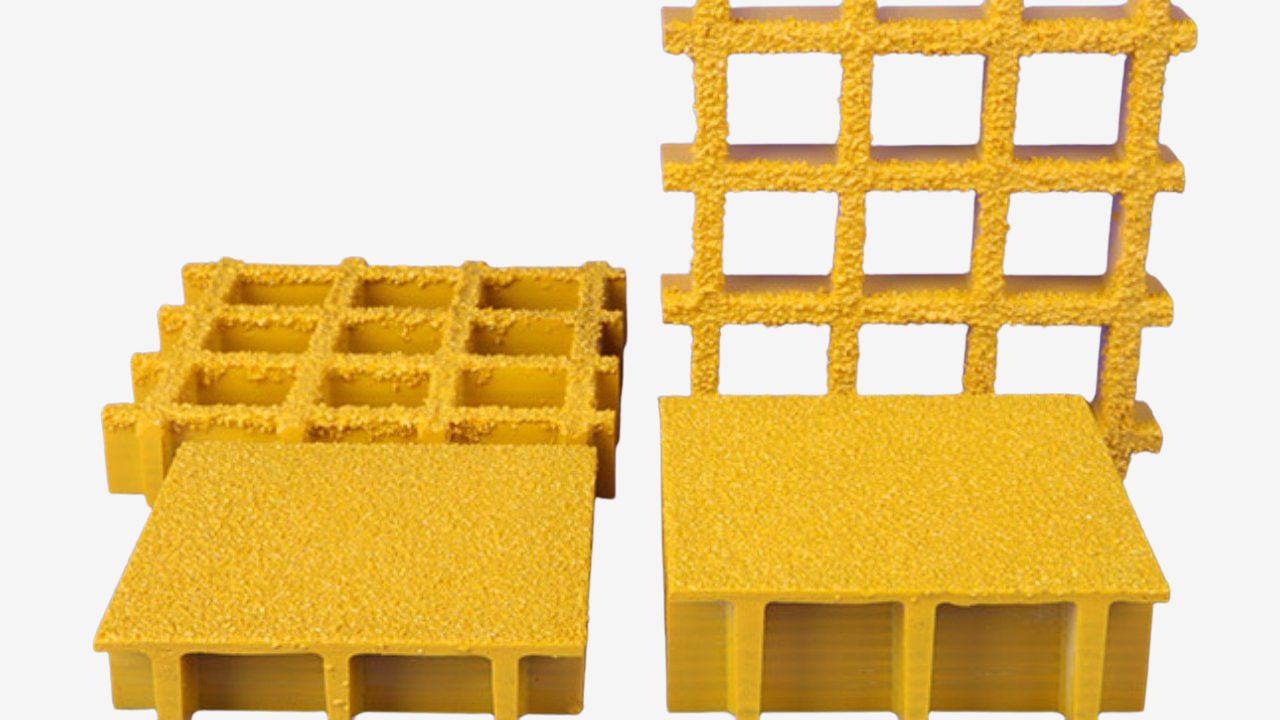
In factories, chemical plants, and wastewater treatment facilities, water, oil, and other liquids can make walkways and platforms slippery, affecting the safety. Selecting the right anti-slip FRP grating requires more than selecting a rough surface. This article will help you select anti-slip FRP grating for walkways and other situations based on the surface types, application scenarios and factors to consider.
What Is Anti-slip FRP Grating
Anti-slip FRP grating is a type of glass fiber reinforced plastic grating that enhances walking friction through surface structure or anti-slip treatment. Compared to a smooth surface, anti-slip grating usually adopts concave structures, raised patterns, or gravel coatings, enabling a more effective friction contact between the shoe sole and the grating surface. They are commonly used in industrial walkways, equipment maintenance platforms, stair treads, drainage areas, and other places prone to moisture or contamination.
You should note that the anti-slip performance is not only dependent on the surface patterns, but also related to the type of liquid, the degree of contamination, the material of the shoe sole, the installation method, and the actual application conditions. Therefore, you cannot judge the anti-slip effect only based on its name. In necessary cases, you should refer to relevant test data.
Why Choose Anti-slip FRP Grating
Improvement of Safety
On wet floors, the water film may reduce the friction between the shoe sole and the ground. FRP grating with appropriate anti-slip structures can improve the contact conditions and reduce the risk of slipping.
For production areas, outdoor platforms, and drainage cover plates that are frequently washed, it is particularly important to select surface structures that match the environment. If there are oils, chemicals, or other viscous contaminants on the site, you should conduct an assessment in combination with cleaning procedures and specialized anti-slip tests.
Excellent Performance in Corrosion Resistance
The corrosion resistance of FRP grating mainly depends on the resin system, the glass fiber structure and the manufacturing quality. Selecting the appropriate resin for specific chemical media can make your FRP grating suitable for many industrial environments where metals are prone to corrosion. For example, in sewage treatment facilities, chemical processing areas and some coastal industrial sites, FRP grating can reduce the common rusting problems of metal grating. However, not all FRP gratings can withstand all acids, alkalis or solvents. When selecting, you should confirm the type, concentration, temperature and contact time of the medium.
Convenient for Drainage and Daily Maintenance
The open structure of grating makes water and some debris be discharged through the mesh holes, which can reduce the accumulation of water. In addition, the drainage effect is also related to the mesh size, installation slope, and the drainage system below.
The cleaning requirements for different anti-slip surfaces also vary. For example, the gravel surface may be more prone to retaining small dirt particles, while a relatively smooth surface is usually easier to wipe. For areas prone to accumulating grease, dust, or chemical residues, you should consider cleaning tools and frequencies of maintenance in advance.
Light in Weight and Easy to Install
Compared with many traditional metal grilles, FRP grating boasts lighter weight, convenience for transportation and on-site cutting, which helps to reduce the difficulty of some installation tasks. However, the actual load-bearing capacity of the grating cannot be determined solely based on the weight of the material. You should take all relevant factors containing thickness of the plate, span, support spacing, load type and fixation method into account.
Common Anti-slip Surfaces of FRP Grating
The conditions suitable for different surface structures are different. When selecting, in addition to considering the anti-slip performance of the grating, you should also assess the level of on-site contamination, the frequency of cleaning, and the walking requirements of personnel.
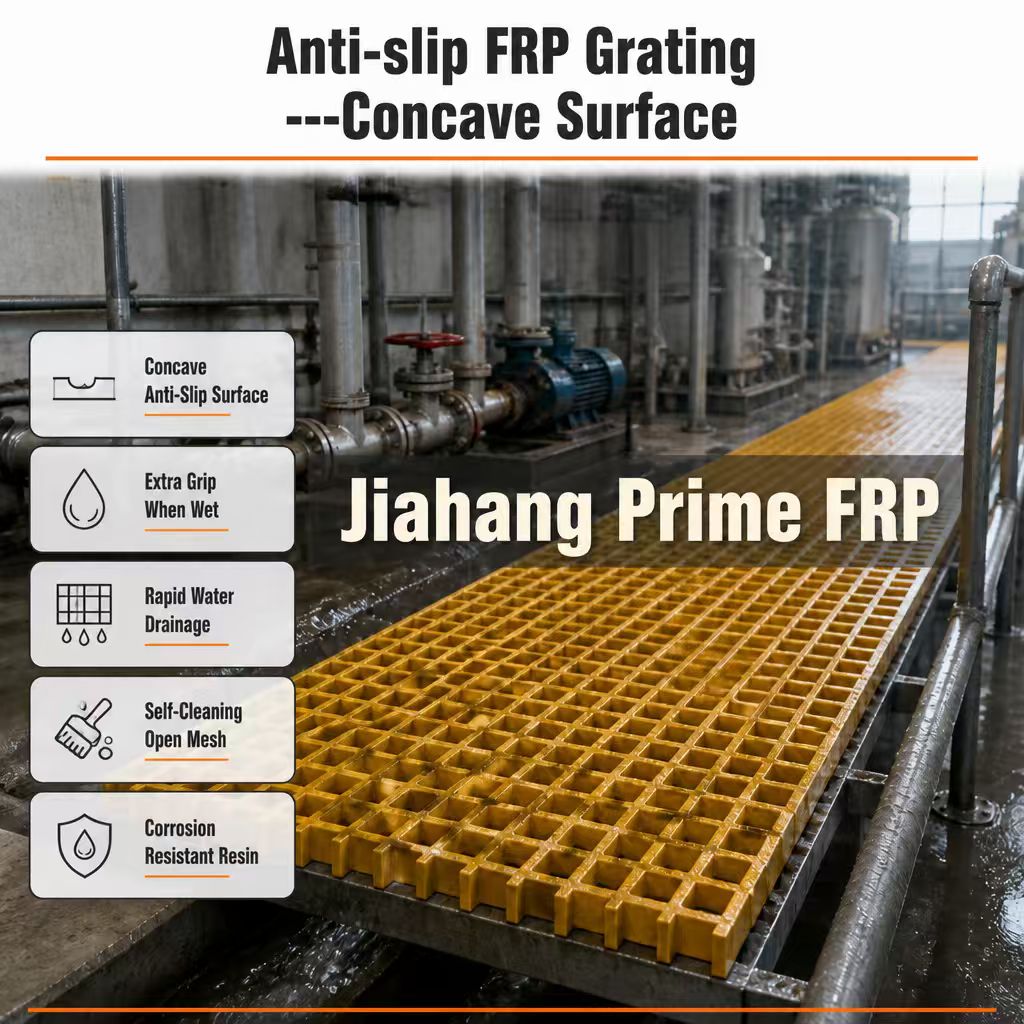
1. Concave Surface
The concave grating features a regular concave surface structure. Compared to a smooth surface, the concave surface can change the contact mode between the shoe sole and the grille, providing a certain anti-slip effect under appropriate conditions.
Anti-slip FRP gratings with concave surface are commonly used in generally damp industrial walkways, equipment platforms, and drainage areas. They are suitable for sites that require both daily passage and basic cleaning maintenance.
However, the concave structure does not mean that water or contaminants will definitely be completely discharged. If oil, sand, or other residues accumulate in the grooves, the anti-slip effect may be reduced. Therefore, the cleaning method and maintenance frequency should be determined based on the actual pollution situation on site.
2. Grit Surface
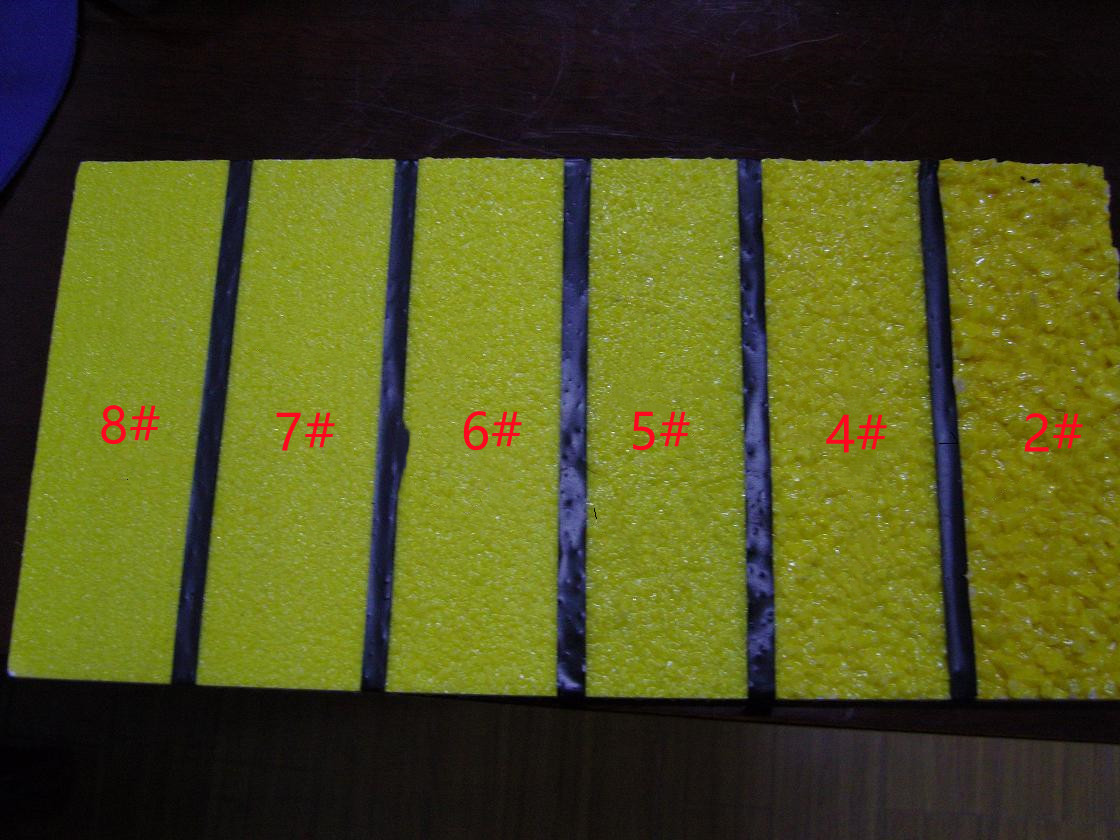
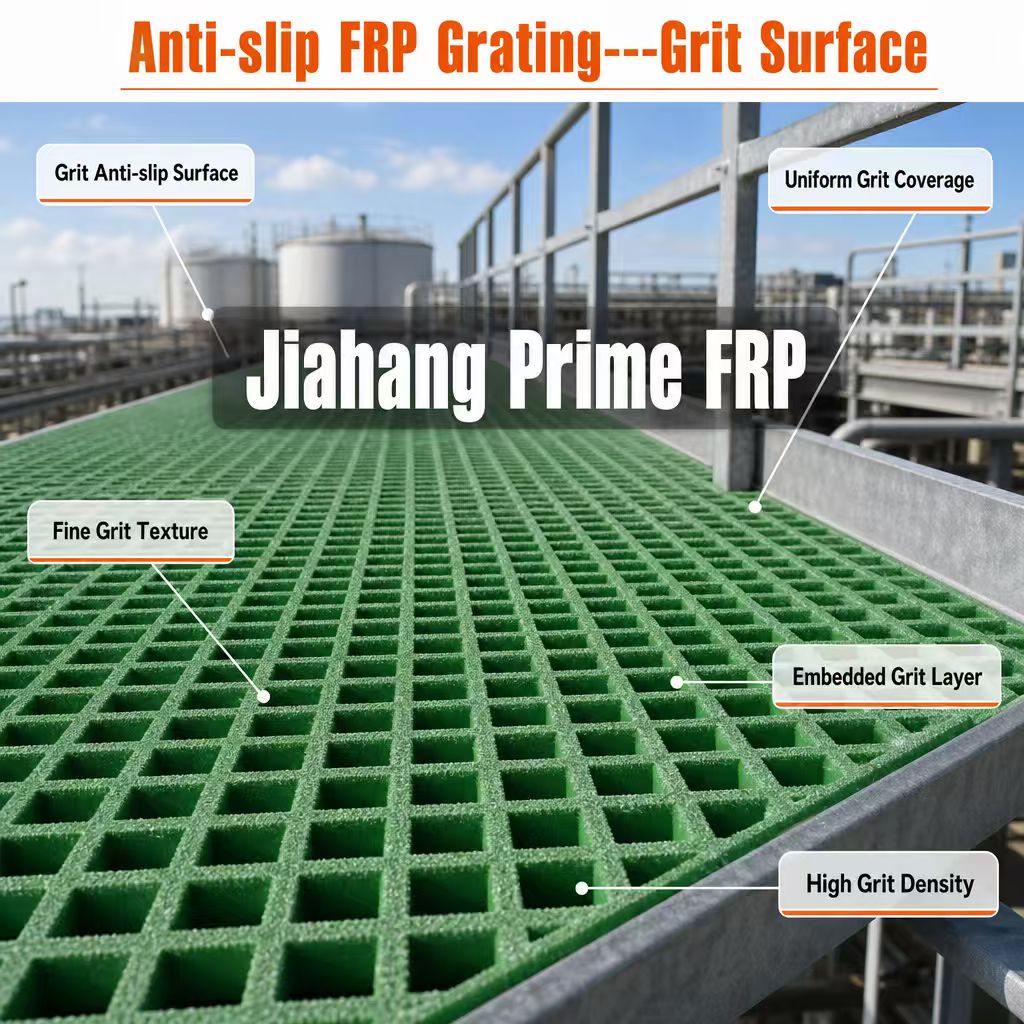
The gravel grating is added a rough anti-slip gravel layer on the surface to enhance the friction between the shoe sole and the grille. For areas with frequent watering, rain, or a certain degree of oil contamination, this surface can be a candidate solution. It is commonly used in industrial walkways, stair treads, maintenance platforms, and some outdoor operating areas.
The specific anti-slip effect of the gravel surface depends on the particle size of gravel, coating quality, and manufacturing process of the FRP fiberglass grating. The rough surface may also increase the difficulty of cleaning, especially in environments prone to oil, fibers, or dust attachment. Furthermore, you should pay attention to long-term wear and the integrity of the coating.
3. Integral Concave-Convex Patterned Surface
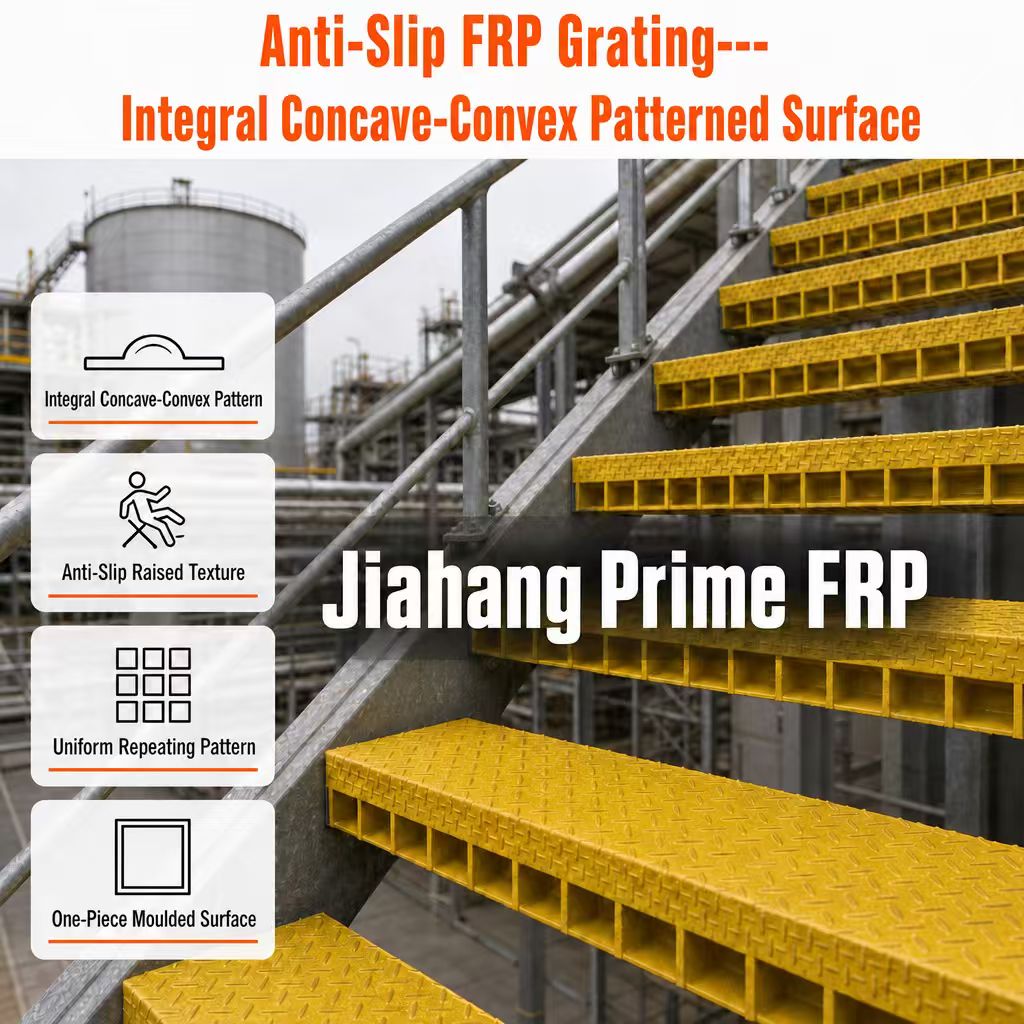
The integral concave-convex patterned anti-slip FRP grating, also called patterned anti-slip grating, features a three-dimensional pattern formed by molds, creating a regular arrangement of raised and recessed textures on the surface. Unlike structures that have sand or gravel applied as a separate layer, this pattern is directly molded into the product itself. The integrated embossed design increases texture variation of the surface and enhances mechanical contact between footwear and the grating, improving slip resistance during walking. Since the pattern is co-molded with the grating body, issues such as peeling or detachment of separate grit coatings do not occur.
This type of surface is suitable for industrial walkways, equipment operating platforms, maintenance walkways, and other areas requiring both textured surfaces and daily maintenance. However, the integral concave-convex pattern does not necessarily have superior slip resistance in all environments. Its actual performance depends on factors including pattern height, spacing, surface condition, and the presence of water, oil, or other contaminants. In areas with severe oil contamination or high slip risk, you should refer to slip-resistance test data from the supplier.
| Performance | Concave Surface | Grit Surface | Integral Concave-Convex Patterned Surface |
| Slip Resistance | Provides practical traction for general damp areas | Rough texture enhances surface friction | Raised and recessed patterns improve surface grip |
| Durability | No separate anti-slip coating | Grit coating may wear over time | Integrated pattern avoids grit coating peeling |
| Cleaning | Relatively easy to clean | Rough texture may retain dirt and oil | No separate grit layer to maintain |
| Surface Structure | Concave texture | Abrasive grit coating | Integral molded texture |
How to Select the Anti-slip Surface in Varied Conditions
You should select the non-slip FRP grating based on the actual conditions on site.
| Application | Main Challenges | Selection Recommendations |
| Indoor Walkways in Factory | Daily moisture and frequent personnel passage | Concave or integral concave-convex patterned surfaces |
| Outdoor Platforms | Rainwater, dirt, and weather conditions | Prioritize slip resistance, drainage, and ease of cleaning |
| Chemical Plants and Chemical Treatment Areas | Liquid splashes, chemical corrosion, and potential contamination | Confirm chemical resistance of the resin first, then evaluate the anti-slip surface |
| Wastewater Treatment Plants | Constant moisture, sludge, and debris | Consider drainage, cleaning requirements, and corrosion resistance |
| Stair Treads | Slip hazards when walking up and down stairs | Choose anti-slip grating suitable for stair tread structures and confirm the fixing method |
| Areas with Heavy Oil Contamination | Oil films may reduce friction | Consider contamination conditions and test data besides surface pattern |
The table is the initial direction to select. You still need to determine the product specifications based on the load, span, supporting structure and applicable safety requirements.
Factors You Need to Consider When Selecting Anti-slip Grating
Actual Slip Conditions
First, you should judge whether there is water, rainwater, oil or corrosive chemical liquids. Different liquids will have different effects on the anti-slip performance of anti-slip FRP grating.
For walkways that are occasionally damp, the basic anti-slip texture may already meet your requirements for slip resistance; for areas that are constantly waterlogged or have oil stains, you should make a more careful assessment of the properties of the anti-slip FRP grating.
Load Capacity and Supporting Span
The anti-slip property cannot replace the structural safety requirements as the grating also needs to bear the loads from personnel, equipment or transportation vehicles.
When selecting, you should define the FRP grating thickness, support spacing, load type and allowable deflection, and refer to the load table provided by the manufacturer. If you use the grating on heavy equipment platforms or vehicle passage areas, you should conduct a specialized structural calculation.
Resin Types and Corrosion Resistance
For chemical plants, sewage treatment facilities and industrial areas along the coast, you should select a suitable type of resin based on the actual medium. You can’t simply assume that FRP grating or fiber reinforced plastic grating made of glass fiber reinforced materials is suitable for all corrosive environments.
If there exist high temperatures, strong acids, strong bases or special solvents at the site, you should also confirm the applicable temperature and chemical resistance of the FRP grating with the supplier.
Drainage and Cleaning Requirements
The FRP open mesh grating, also called GRP open mesh grating is conducive to making liquids pass through the mesh, but the surface texture and mesh structure still affect the accumulation of debris and the difficulty of cleaning.
If there is a lot of dust, fibers, grease or sticky residues on site, you should consider the cleaning method in advance, avoiding choosing a surface with a rough texture but is difficult to maintain.
Installation and Fixing Manner
Improper installation of the grating may result in movement, warping or excessive force on a specific area. When selecting, it is necessary for you to simultaneously confirm the layout of the support beams, the size of FRP grating panels, FRP grating clips and the fixed positions. For fiberglass stair treads and work platforms that are frequently subjected to impact, you should also pay special attention to the grating panels’ edge fixation and stability for a long-term use.
Common Misunderstandings When Selecting Anti-slip Grating
Misconception 1: The rougher the pattern, the better the anti-slip effect.
The actual anti-slip performance is related to the shape of the pattern, the material, contaminants, and the condition of the sole. You cannot draw a reliable conclusion by simply comparing the appearance.
Misconception 2: FRP grating surface with anti-slip properties is suitable for all damp environments.
The risks of slipping caused by clean water, oil stains, and chemical liquids are relatively different. Severe pollution requires more targeted assessment.
Misconception 3: Only focus on the surface and not consider the load.
Even if the grating surface has excellent anti-slip performance, excessive deflection or even structural damage may occur if the thickness, span, or support spacing of the grating is inappropriate.
Misconception 4: Ignoring cleaning and maintenance.
Any surface may have a reduced anti-slip performance due to oil stains, sand, or other contaminants. Therefore, you should conduct regular cleaning and inspection to maintain the good performance of the anti-slip grating for long-term use.
FAQs
1. What are the differences between the integral concave-convex patterned surface and the grit surface?
The patterns of integral concave-convex patterned anti-slip FRP grating are directly formed on the surface of the grating, while the grating with grit surface usually provides the anti-slip effect through the rough gravel layer attached to the surface. The former does not have an independent gravel coating, while the latter needs to pay attention to the wear and integrity of the coating. You should evaluate the actual anti-slip performance of the two based on the structure of the grating and test data.
2. Is anti-slip FRP grating suitable for outdoor walkways?
Yes, anti-slip FRP grating is suitable for a number of outdoor walkways, including industrial access paths, docks and maintenance platforms. Its corrosion resistance and lightweight structure make it effective in exposed environments. For long-term outdoor use, you should select based on the weather conditions, structural loads and the required service environment.
3. Can anti-slip FRP grating be used for drain covers?
Yes, anti-slip FRP grating can be used for drainage covers in factories, wastewater treatment facilities and industrial service areas. Its open mesh structure makes water pass through, while the textured surface can improve walking traction. The panel must be designed for the expected load and supported correctly to prevent excessive deflection or damage.
4. Can anti-slip FRP grating be used in areas with forklift traffic?
Some FRP grating systems may be designed for specific wheel loads, but standard pedestrian grating should not automatically be assumed suitable for forklift traffic. Wheel loads can create concentrated stresses that differ significantly from pedestrian loads. You should confirm the wheel load, contact area, support span and loading frequency, and obtain engineering verification for the proposed installation.
5. Does anti-slip FRP grating require regular maintenance?
Yes. Anti-slip FRP grating generally requires less maintenance than conventional steel grating because it does not rust like carbon steel. However, regular cleaning and inspections are still necessary. You should have a regular check for cracks, loose fasteners, surface wear and accumulated contaminants. The inspection frequency should be based on the operating environment and the traffic conditions.
Final Thoughts
When selecting fiberglass anti-slip grating, you should take factors containing surface structure, environments, load capacity, corrosion resistance and daily maintenance requirements into consideration. For damp industrial walkways and equipment platforms, you can evaluate the surface according to the type of liquid, passage frequency and cleaning conditions at the site first. Then, you should consider the the load table, material properties and actual test results.
Jiahang Prime FRP is committed to offering one-stop solutions for composite materials. If you want to learn more, welcome to look through our website —Jiahang Prime FRP and contact us at any time.