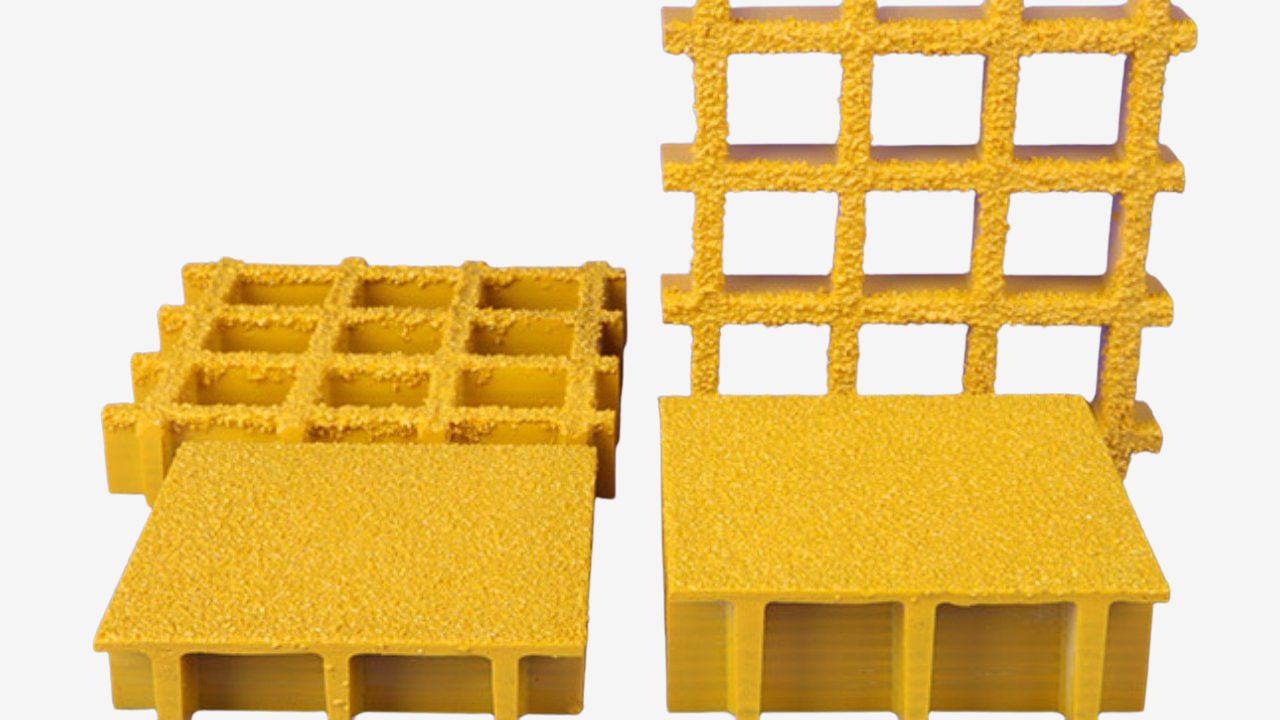
FRP grating is a composite material mainly consisting of glass fibers and resin. As resin directly affects the properties of FRP grating, your selection of resin is crucial to FRP grating. This article will introduce the following topics to you in detail: the selection principles, four types of resins, advantages and disadvantages, and how to select the right resin.
The Functions of Resin in FRP grating
The main character of resin in fiber reinforced plastic grating is to serve as a binder, bonding the glass fiber strands or fabric layers into a composite material. It also provides the grating with certain mechanical strength and weather resistance. The quality of the resin plays a decisive role in the properties of FRP fiberglass grating as following.
- The mechanical properties: The selection of resin has an influence on the mechanical properties of the FRP grating, such as tensile strength, flexural rigidity, and toughness.
- Corrosion resistance: The resistance of the resin to environmental factors, such as its tolerance to acids, alkalis, salts and other chemicals, directly affects the lifespan of the fiberglass grating.
- Temperature resistance: The thermal stability of the resin affects the long-term performance of the fiberglass gratingin high-temperature environments.
- Machinability: The fluidity of the resin, the curing speed, and the molding performance all have great influences on the efficiency and cost of the manufacture process.
- Appearance and maintainability: The color, UV resistance and aging resistance of the resin are all significant factors that affectthe appearance, quality and lifespan of FRP grating.
Therefore, when selecting resin, you need to take all the factors above into comprehensive consideration to select the right type of resin for your application.
The Common Types of Resin
The followings are several common types of resin for FRP fiberglass grating.
1. Unsaturated Polyester Resin(UP)
Polyester resin, which is widely used in the manufacture of fiberglass grating, is the most common type of resin. Polyester resins, including unsaturated polyester resins, polyurethane resins, vinyl ester resin, epoxy resin and phenolic resin, etc, have good mechanical properties, low cost, and wide applicability.
Benefits:
- Lower cost: The price of polyester resin is relatively low, making it the most economical resin for FRP fiberglass grating.
- Good mechanical properties: As polyester resin possesses strong tensile strength, bending resistance and toughness, you can apply it to general load conditions.
- High adaptability: Polyester resin has better corrosion resistance to chemicals, so you are able to apply it toa wide range of industrial project
- Fast curing speed: It is suitable for mass production and can improve the production efficiency.
Drawbacks:
- Poor heat resistance: The heat resistance of polyester resin is relatively poor as it can only be used within 60℃.
- Poor chemical resistance: Because of its poor resistance to certain chemicals, such as strong acids and strong alkalis, its application conditions is limited.
- Rapid aging: Under ultraviolet radiation for a long period of time, polyester resin is prone to aging, resulting in problems such as brittleness, color fading and so on.
Application circumstance: You can applied UP to industry, construction and transportation facilities that have relatively low requirements on corrosion resistance and temperature resistance.
2. Epoxy Resin(EP)
Epoxy resin is a type of thermosetting resin, possessing remarkable properties, high mechanical strength, excellent chemical resistance, and good thermal stability. The epoxy resin is becoming increasingly applied in FRP fiberglass grating, especially under severe circumstances.
Benefits:
- Excellent corrosion resistance: Possessing outstanding chemical corrosion resistance, epoxy resin enables to resist the corrosion from most acids, alkalis, and salt solutions. Therefore, you can apply it tocorrosive environments such as chemical plants and wastewater treatment facilities.
- Good thermal stability:Epoxy resin can endure high temperatures, and you can use it at temperatures below 150℃ for a long period of time.
- Superior mechanical properties:Epoxy resin has excellent tensile strength and flexure strength, making it suitable for applications requiring high loads.
- Outstanding adhesive properties:The excellent bonding properties between epoxy resin and glass fibers improves the overall performance of the composite material.
Drawbacks:
- High cost: The price of epoxy resin is relatively high, which increases your production cost.
- Long curing time: The curing speed of epoxy resin is relatively slow, which affects theproduction efficiency.
- High brittleness: Epoxy resin has poor toughness and is prone to cracking.
Application circumstance: You can apply it to conditions with high temperatures, high loads and severe chemical corrosion, such as chemical facilities, oil platform, offshore facilities, etc.
3. Phenolic Resin(PF)
Phenolic resin is a kind of thermosetting resin with excellent high-temperature resistance and flame retardancy. You can use it in particular occasions requiring high-temperature resistance and fire resistance.
Benefits:
- Excellent high-temperature resistance: Phenolic resin far outperforms polyester resin in terms of high-temperature resistance. So you can use it in conditions with temperatures above 200℃ for a long time.
- Flame retardancy: Phenolic resin possesses natural flame-retardant properties, which contributes to slowing down the spread of fire during a fire.
- Superior chemical resistance: Phenolic resin makes a great difference in resisting a number of corrosive substances such as strong acids and strong alkali.
Drawbacks:
- High production costs: The production cost of phenolic resin is relatively high, and it is suitable for special circumstances with high requirements for high-temperature resistance.
- Hardness and brittleness: If you need to apply the resin to situations demanding high-toughness, phenolic resin is not suitable as it has poor toughness, and is prone to cracking under force.
Application circumstance: You can apply it to circumstances requiring high-temperature resistance and fire protection, such as the outer covers of high-temperature equipment, power facilities, and high-temperature furnaces, etc.
4. Vinyl Ester Resin(VE)
Vinyl ester resin features excellent corrosion resistance and higher strength, suitable for harsh environments.
Benefits:
- Excellent corrosion resistance: Vinylester resin has excellent performance in chemically corrosive environments. It is practical for you to apply it in environments with strong corrosiveness such as acids and alkali.
- Outstanding mechanical properties: Based on itsexcellent tensile strength and flexure strength, vinyl ester resin is suitable for high-load applications.
- High-temperature resistance: Considering temperature resistance, vinyl ester resin outperforms polyester resin, so you can apply it to environments withrelatively high temperatures.
Drawbacks:
- Higher price: Compared with other types of resin, vinyl ester resin is more expensive because of its relatively high production costs.
- Slower curing speed:Vinyl ester resin requires a longer curing time, which reduces the production efficiency.
Application circumstance: You can use it to circumstances where corrosion resistance and high-temperature resistance are required.
| Comparison aspects | Unsaturated Polyester Resin(UP) | Epoxy Resin(EP) | Phenolic Resin(PF) | Vinyl Ester Resin(VE) |
| Corrosion resistance | general | excellent | good | excellent |
| High-temperature resistance | poor, below 60℃ | good, can be used below ≤150℃ for a long time | excellent, can be used above 200℃ for a long time | superior to UP |
| Flame retardance | general | general | excellent | ordinary |
| Environments | General industry, construction, transportation facilities | High-temperature, high-load, highly corrosive environments | high-temperature, fire-resistant environments | Highly corrosive, relatively high temperature environments |
| Typical applications | general industrial projects, construction, transportation facilities | chemical plants, wastewater treatment facilities, oil platform, offshore facilities | high-temperature equipment covers, power facilities, high-temperature furnaces | Highly corrosive environments and high-load applications |
The Principles of Selecting Resin
When selecting resin, you should have a comprehensive consideration according to the application environments, property requirements and economical factors of FRP grating. You need to take the following key points into account.
- Chemical resistance: For environments with severe chemical corrosion, such as chemical plants, wastewater treatment plants, you should select epoxy resin, vinyl ester resin or phenolic resin, so that the fiberglass grating can be used stably for a long period of time.
- High-temperature endurance: For environments requiring high-temperature resistance, such as high-temperature equipment and boilers, you had better select epoxy resin or phenolic resin possessing high-temperature property.
- Mechanical properties: As to applications that have high requirement for load, such as industrial platforms, overloaded channels and so on, you are supposed to select epoxy resin or vinyl resin with high tensile strength and flexural strength.
- Costs: For general loads and non-demanding environments, you can choose polyester resin with relatively low price.
- Manufacturing technique: Consider the curing speed of resin, levels of processing difficulties, etc and choose the right resin to improve the production efficiency.
Frequently Asked Questions
1. Does the resin content of FRP grating affect properties of the products?
Yes. Resin content influences the strength, corrosion resistance, and surface quality of FRP grating. Insufficient resin may result in inadequate glass fiber encapsulation, while excessive resin can affect reinforcement. Therefore, the proportion must be properly controlled.
2. Does FRP grating with different colors use different types of resins?
Not certainly. The color of FRP grilles is usually made by adding pigments or color pastes, and it does not mean a specific resin must be used. However, for outdoor products, the durability and color stability of the resin should also be considered.
3. Can FRP grating be made with mixed resins?
It can be done under certain circumstances, but formulation and technique verification are required. As different types of resins may have different curing conditions and chemical properties, the properties of FRP grating and production stability might be affected if mix directly.
4. How to judge the quality of the resin used in FRP grating?
You can judge according to the technical parameters of the resin, the properties and the test reports. Besides, you need pay more attention to the properties, corrosion resistance, temperature resistance and aging resistance, and make an assessment based on the practical application.
5. Will the type of resin affect the maintenance of FRP grating?
Yes. Different resins have different tolerances to temperature, chemical media and ultraviolet rays, so the requirements for maintenance also vary. Besides, the condition of FRP grating should be checked regularly based on the practical environment when in use.
Final Thoughts
Resin is crucial to the properties of FRP grating. Polyester resin can be used in general environments, epoxy resin is suitable for harsh conditions, phenolic resin can be applied to high-temperature circumstances, and vinyl ester resins are suitable for highly corrosive environments. In short, you should consider your practical situation to select the appropriate resin. If you want to learn more, welcome to visit our website Jiahang Prime FRP and contact us.